Skip to content

Staying safe for fall and winter hiking

As an avid hiker and backpacker, I have experienced the PNW in all its weather elements. I am the Chair of the Mountaineers Foothills Branch Backpacking Committee, Co-Creator and Administrator for a beginning hiking series called GoHike, and an urban walk leader. My emphasis on safety is a priority. I help participants gain confidence, practice leave no trace principles and foster a space for belonging. I welcome all levels of physical abilities and create a community of outdoor enthusiasts who take care of one another on the trails.

The wintry weather is here, and safety essentials are necessary on our trails. We need options for the wet, cold, and snowy trails to recreate on. Snow fans rejoice this time of year because snowshoeing, skiing and snowboarding opportunities abound. But what about the rest of us who just want to get on the trails and hike? While it can be exciting to hike in snow, see animal tracks, and be in awe of frozen waterfalls, lakes and experience the moody, misty wonders of our PNW trails, additional safety measures are essential.

Fortunately, with a little knowledge, prep, and awareness, hiking safely in the colder months is possible.

What can I do to prepare?

Be aware of the conditions of the roads and trails before you go.

Bring a map – dI cannot emphasize how important a map is and knowing how to use it! Check out the smartphone apps Gaia or All Trails to download maps to use offline while hiking. Both have affordable subscription rates. Paper maps are also available at local outdoor retailers. Remember, phones can die, so bring your battery pack and a paper map as a backup.

Know before you go! Check out Washington Trails Association for current trip reports, weather forecasts, current conditions, and parking passes required at trailheads.

Captured by Christina Buckman

What are the essentials for hiking during the fall/winter?

1. Always bring the 10 essentials, regardless of the season!

  • Headlamp/sun protection/first aid/knife/fire starter/shelter (emergency bivy)/extra food, water, and clothes.
  • Consider hiking poles: They help with joint impact and balance.

2. Reduced visibility is often the case in the colder hiking season. Know the forecast, and prepare for it to change.

3. Best practice is to not go alone, but if you do, tell someone where you will be, and when you expect to be back. Providing GPS coordinates of the trailhead you start at is an immense help should you need someone to help in an emergency. GPS coordinates can be obtained on Google Maps by clicking on the location of the trailhead. Copy and paste in the message you send to your emergency contact.

4.Be aware of hypothermia and the signs that could mean trouble.
Never wear cotton. A hiking cardinal rule! If it gets wet in our climate, it will not dry and can cause hypothermia to set in fast. Wear wool or synthetic layers and have extras just in case.

5. Proper footwear.
Unless you are snowshoeing, on skis or boards, hiking on trails may sometimes require strap-on micro-spikes or Yaktrax. They are inexpensive and will give you the added confidence on trails that may be icy or snowy. Make sure to have hiking boots that have good traction and are waterproof, to keep your feet from getting wet. Dry feet are happy feet!

Captured by Christina Buckman

What are other resources for information on hiking and other outdoor adventures?

My go-to is Washington Trails Association– Not only does it have the most comprehensive trail database with search components to cater to your needs, but timely articles, current trip reports and opportunities to give back. We owe a great deal of thanks to those diligent WTA volunteers who spend time on the trail keeping it safe for us.

The Mountaineers – With a myriad of courses, clinics and seminars spanning a variety of activities, the options are endless, and you know you will be well cared for with expert leaders. Scholarships available for memberships and courses.

REI Expert Advice

REI Uncommon Path: Blog

Where can I get inspired?

Instagram can be a great resource for inspiration, without having to read long articles or blog posts. Check out the IG handles I follow below for diversity, inclusivity, body positive profiles, helpful tips, and travel pics for inspiration.

  • Her PNW Life – community of adventurous women in the PNW
  • Issaquah Alps Trails Club – Dedicated to engaging the public to preserve, protect & promote the land, wildlife, and trails.
  • The Mountaineers – Nonprofit, volunteer-led org working to inspire a lifetime of outdoor adventures.
  • Brown Girl Outdoor World – Black, Indigenous and Anti-racist POC 2SLGBTQ+ in the outdoors
  • She Colors Nature
  • Unlikely Hikers – Body liberation and anti-racism outdoors
  • Women Who Hike – Empowering women who hike on and off the trail.

Captured by Christina Buckman

How can I build community?

Having a sense of belonging and community as outdoor enthusiasts is essential, and incredibly rewarding. I highly encourage you to research options where you can meet new people, to learn from and be inspired by one another. My volunteer work with the Mountaineers has been and continues to be, the greatest source of my inspiration. The best part is making lifelong friendships and connections. We are fortunate to live in a state surrounded by water and mountains. Get out there, be safe, have fun, and hike on!


Christina Buckman (she/her) is a UW Alumni and works as an Academic HR Business Partner on the Bothell Campus. As an employee of the University for 11 years, she is proud to be a Husky. As an avid hiker and backpacker, she is a mentor and leader with the Mountaineers, where she focuses on safety, inclusivity, body positive mentorship and makes sure everyone feels a sense of belonging as she shares her passion for the outdoors.


Get up, stand up: Combatting “Sitting Disease”

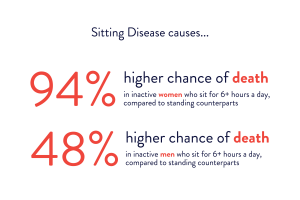
Sitting is something so commonplace we often don’t realize just how much of our day is truly spent sedentary. However, sitting for too long can have many negative impacts on health and longevity. A 2011 study in the American Journal of Preventative Medicine found that prolonged sitting was associated with an increased risk of 34 chronic diseases including obesity, diabetes, cancer, and cardiovascular disease. Yikes!

A typical American is sedentary for 21 hours out of the day. Including exercise and physical activity, people across the U.S. only spend approximately 3 hours out of the day simply standing.

This phenomenon has been coined as “Sitting Disease,” which, broadly speaking, is defined as a condition of increased sedentary behavior associated with adverse health effects. Sedentary behavior can be defined by two things: the position you are in, which is generally reclining or sitting, and the amount of energy expenditure that your body is experiencing.

You may be asking yourself, “But I work out every day, does this still apply to me?”

Unfortunately, according to The Journal of Medicine and Science in Sports and Exercise, the “Active Couch Potato” phenomenon states that even an active person who works out five times a week still faces the risks associated with “Sitting Disease” if they are living a sedentary lifestyle outside of the gym. Unfortunately, you can’t undo eight plus hours of sitting with a workout!

Although participating in moderate to vigorous exercise 3-5 times a week is recommended, it’s important to start with the first step: standing. Dr. Brian Liem, MD, FAAPMR, from UW Sports Medicine, says that a “lifestyle of prolonged sitting is distinctly different even from a lifestyle absent of routine exercise.”

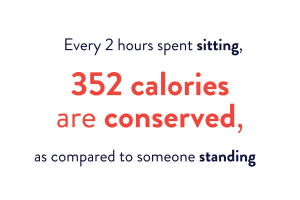
A study at Mayo Clinic found that for every 2 hours spent sitting 352 calories are conserved as compared to someone standing. Dr. Liem emphasizes that “standing can help get some of that metabolic activity back up because standing causes contractions in your postural muscles in your back, hips, and knees to keep you upright.”

The majority of Americans stare at a computer screen during the day, whether it be at an office desk or at home. If not, we are looking at the computer in our pockets – our smartphones. An average office worker sits for 15 hours every day, which calculates to about 80,000 hours spent sitting over a lifetime.

Technology has become an accepted part of our everyday lives, but that doesn’t mean we shouldn’t be cognizant of what our bodies are doing while we are using technology.

Staring at your computer with poor posture causes the development of a hump at the top of your back, the shortening of your hip flexors, shortened abdominal muscles, a caving chest, weakened shoulders, arm pain, numbness and tingling in your extremities, and worst of all, traumatic pressure on the disks in your back. All of these symptoms are not uncommon.

Good posture is also important when using a smartphone because a human head weighs about 10–12 lbs. Studies show that bending your head down to the 60-degree typical texting position can make your head weigh about 60 lbs. We spend about 700 – 1,400 hours on our smartphones every year, so putting that much stress on our necks and spines just by bending our heads for that long can start to develop problems.

So, what are some solutions?

We know that it is difficult to be removed from technology and that many common solutions can be expensive or difficult to find on the market. Instead, we emphasize the importance of awareness in terms of your posture, bodily movement, and the amount of sitting/reclining per day.

For every hour of sitting, try to get about ten minutes of standing in. For every 30 minutes that you are doing work, there should be 20 minutes of actual computer work, and then a 10-minute break. That 10-minute break should be 8 minutes of standing and 2 minutes of stretching. This alone is a pretty big change from sitting for hours on end, and should over time give back to your body exponentially.

Incorporate movement breaks into your day

Check out the Whole U’s Flex at your Desk and Stretch at your Desk handouts to learn a few movements that you could try at work. We also encourage you to join The Whole U’s daily movement class at 11 a.m. 15-minutes of stretching and light movement to give your body a much needed sitting break.

When you are sitting, think of an ergonomic posture – bringing your keyboard and mouse closer to your body, keeping your shoulder blades pulled back, relaxing your elbows by your side, and maintaining a neutral spine. The Whole U’s Working with Better Posture handout is a great place to start.

Learn more by watching 2 recorded webinars

Working Ergonomics with Dr. Peter Johnson

Join Dr. Peter Johnson, Professor Emeritus, Environmental and Occupational Health Sciences, and Adjunct Professor of Industrial and Systems Engineering to learn everything you need to know about creating an ergonomic workspace—wherever you’re working! Click here to download Dr. Johnson’s updated slides. 

Sitting Disease Deep Dive with UW Sports Medicine

Elliot O’Connor, DPT, and Dr. Brian Liem from UW Sports Medicine share information about what sitting disease is, how it can lead to chronic back and neck pain, and provide some simple exercises that you can do to prevent and beat the sitting disease.

Small steps can make a big difference – literally!

You can also combat “Sitting Disease” through small things. Try parking farther away, standing while you eat lunch, and doing one-leg balance stances while you watch television or brush your teeth. Every little step you take is one less moment spent sitting.

Alongside standing, aerobic exercise is extremely important. As recommended by the HSS, you should be performing a minimum of 30 minutes of moderate intensity aerobic activity about 5 days a week or 20 minutes of vigorous intensity aerobic activity about 3 days a week.

Campus is your playground: find movement and mindfulness right outside your office door

The University of Washington is one of the most beautiful educational settings on earth, a sublime marriage of eclectic architecture and verdant landscape.

That landscape certainly provides an inspiring platform for learning. But it also serves up myriad great places to exercise — both body and soul.

UW Botanical Gardens

The relative quiet and dependably sunny skies of summer quarter make it the perfect time to explore the many spots on campus conducive to movement or mindfulness. And every little bit counts.

“Summer is an amazing time to get outside for exercise or your physical activity ‘snack,’” says Dr. Jonathan Drezner, MD, director of the UW Medicine Center for Sports Cardiology and team physician for the Washington Huskies, Seattle Seahawks and OL Reign. “Our beautiful UW campus offers many areas to walk, jog, climb, swim and explore!”

Join us on a wellness tour of the UW as we count some of the ways that campus can be your playground.

Prime movers

We should first introduce one of the principal protagonists of any story on campus wellness: UW Recreation, which serves faculty, staff and retirees as well as current students of all three UW campuses.

UW Rec manages multiple-use sports fields, courts and facilities, organizes a litany of intramural leagues and tournaments, coordinates club sports, hosts wilderness adventures — even rents outdoor equipment.

“UW Recreation offers a multitude of options for recreation, fitness, wellness and fun,” says Katie Beth, associate director for facilities and operations at UW Recreation. “Rent a boat at the Waterfront Activities Center to paddle on Union Bay, hit a bucket of balls at the Golf Range, play soccer, flag football, ultimate, tennis, sand volleyball or basketball on the outdoor fields and courts, go bouldering at the outdoor Husky Rock, rent outdoor equipment from the Gear Garage and the Waterfront Activities Center, join an Intramural team to play a sport with friends, or join a Rec Club team to play either recreationally or competitively, and go on a trip with the UWild Adventures program.”

We’ll unpack more of this later. But before we venture outside, let’s explore…

The great indoors

UW Recreation manages the IMA (or Intramural Activities Building) on the Seattle campus, a deluxe athletic club available at deeply discounted cost for those of us fortunate enough to be associated with the UW (plus our plus-ones).

The IMA

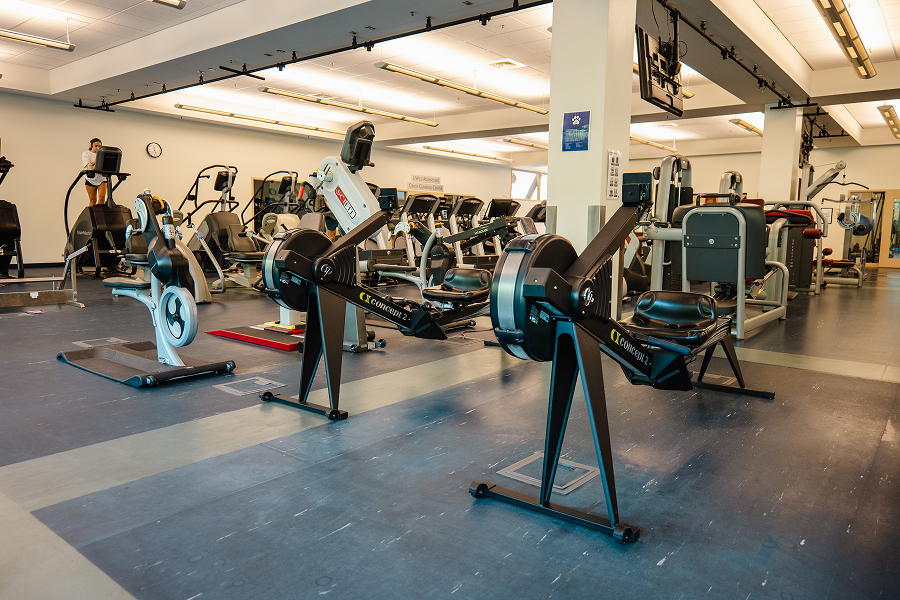
It would take an entire article to list the entire catalog of fitness and wellness and activities and resources on offer. In short, the IMA has legions of cardio and strength-training machines, a calendar full of classes on fitnessmindfulness and yogasports skills and martial arts available with a Rec Class Pass. There’s indoor climbing and boulderinglap swimming and pickup basketball, volleyball, badminton and pickleball, plus roller skating, archery or log rolling on certain Friday nights. You can run/walk laps around an indoor track-with-a-view, work with a personal trainer, get a nutrition consultation or enjoy a massage.

UW Bothell is served by the Activities and Recreation Center (ARC), an indoor fitness center and outdoor sports & recreation complex offering cardio and strength equipment and wellness classes, outdoor skills classes and group adventures, plus and a wide range of intramural sports (open to faculty and staff, too).

UW Tacoma features the onsite University YMCA Student Center — which is open to faculty and staff with a YMCA membership (joining fee is waived). The University Y offers a variety of fitness and recreation services, cardio and strength equipment, a basketball court, a track, a climbing wall, reflection room, daily fitness classes — even a piano for those who like to tinkle the ivories.

Games people play

UW Recreation is your portal to a wide range of sports that revolve around a ball (or other roundish object). Game play happens inside the IMA, in its warren of basketball, racquetball, squash and badminton courts, and outside the IMA, among the nearby network of tennis and sand volleyball courts and athletic play fields.
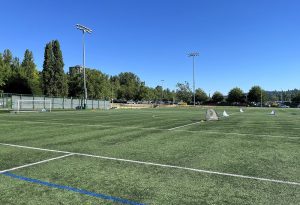
UW Recreation play fields

Across the E-1 and E-18 parking lots lies the UW Golf Range, an on-campus chance to work on your stroke while exorcising the day’s frustrations at the business end of a driver. Farther east on Clark Rd., find another patch of utilitarian grass and turf play fields.

These facilities are home to Intramural Sports (also run by UW Recreation). And they are not just for students. Intramurals are also open to UW employees and plus-ones with a UW Rec membership. You can participate in single-gender or co-ed leagues and tournaments. And the list of sports is extensive, including flag football, volleyball, sand volleyball, basketball, inner-tube basketball, pickleball, kickball, dodgeball, wiffleball, spikeball, softball, soccer, futsal, ultimate, tennis, table tennis, badminton, cornhole, Kan Jam and something called water battleship.

There’s even a recreational division just for faculty, staff and grad students engaging in flag football, basketball, soccer, softball and volleyball. Don’t have a team for any of the leagues? You can sign up as a free agent.

Feeling more ambitious? UW employees are also eligible to participate in any of 40 Rec Clubs, which transcend the traditional ball sports to encompass aikido, archery, climbing, equestrian, ice hockey, rowing, running, skiing and wrestling, to name just a few.

Exploring on foot or by wheel

The UW’s sprawling Seattle campus is the hub of a chain linking multiple magical park lands managed by both the University and the City of Seattle — all intersected by the venerable Burke-Gilman Trail, a converted rail line that winds through campus on its 19-mile route from Ballard to Kenmore at the top of Lake Washington.

This all adds up to miles and miles of idyllic trails — both earthen and paved — radiating from campus on which to run, walk, bike, scoot, skate or scamper to your heart’s delight.

Traveling eastward, spy a bald eagle, heron, Anna’s hummingbird or solitary sandpiper amid the restored wetlands and shoreline of the UW’s Union Bay Natural Area, one Seattle’s finest birding sites.
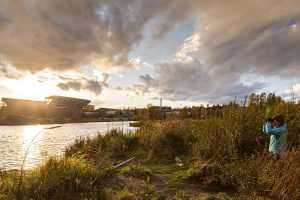
Union Bay Natural Area

While passing through this eastern outpost of the UW Botanical Gardens, see what’s in season at the UW Farm, survey the lovely landscaping of the Center for Urban Horticulture, and commune with the resident turtles and ducks along the zigzagging boardwalk through Yesler Swamp. Extend your jaunt via the Burke-Gilman a few miles further to the play fields, meadows and wetlands of sprawling Magnuson Park, on the site of a decommissioned naval base along the shores of Lake Washington.

Across the Montlake Bridge to the southeast of campus, loop through brushy Foster Island (when the trail is passable) and on to the charming hillocks and meandering paths of the Washington Park Arboretum — another of the UW Botanical Gardens — to experience a diverse collection of horticulture in an Edenic setting. Want even more green? Continue uphill to via the fairy-tale fern gully of Interlaken Park all the way Volunteer Park and its iconic red brick water tower, whose commanding view is accessible to all who are willing to ascend its corkscrewing staircase. Consider returning to campus via Montlake Playfield, through its hidden underpass trail that bypasses much of the 520 construction mayhem, and maybe buzz by sunny Fritz Hedges Waterway Park, the city’s newest, on Portage Bay.
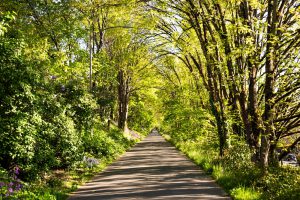
The Burke-Gilman Trail

To the north, the Burke-Gilman will take you to the lush valley linking Cowen and Ravenna Parks, where you can follow parallel creek paths a few miles toward Green Lake, Seattle’s social and fitness epicenter, and the undulating paths, popular playfields and prominent zoological gardens of Woodland Park.

Find fine stretches of trail, too, in and around the forested campus of UW Bothell. Explore the sprawling wetlands bisected by the North Creek Trail (home to the famous nightly congregation of crows), which connects to the Sammamish River Trail all the way to Redmond and the Burke-Gilman south to Seattle.

And while UW Tacoma’s urban campus is situated in the historic heart of the City of Destiny, it not far from the arboreal splendor of Wright Park and the string of shoreline parks leading north to Point Defiance Park, the lovely peninsula in Commencement Bay encompassing forest, meadow, gardens and beaches—plus a zooaquarium and historic Fort Nisqually.

Climbing higher

For those seeking great heights — and the effort to reach them — the UW has some intriguing options.
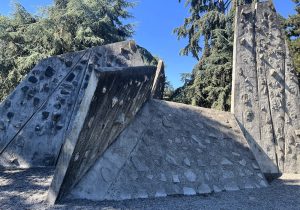
Venerable Husky Rock

Climbers clamber up the artificial monoliths of Husky Rock, which was constructed near the Montlake Cut and historic ASUW Shell House in the 1970s to give adventurous students a safer alternative to scaling the walls of university buildings. Its leaning towers and variety of route types and difficulties draw experts and novices alike. Climbing is free, subject to weather and at your own risk. And mind the goose poop.

Or perhaps a more controlled environment is more your vibe? UW Recreation operates the Crags Climbing Center, three stories of manufactured rock faces rising up the IMA that offer scrambling and roped climbing for all levels. Even if you’d never consider climbing, check out the view balcony beside the running trail for a bird’s-eye view of the vertical action below.

Want to test your mettle on the region’s natural crags? Sign up for a UWild Adventures climbing outing or join the UW Climbing Team.
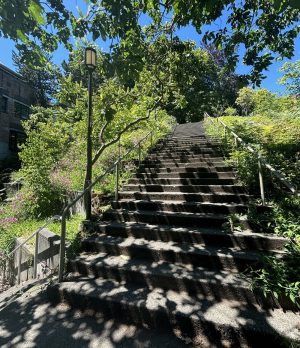
Campus stairs climbing Wahkiakum Lane

For those seeking a less-technical vertical workout, the UW’s central campus is surrounded by open-air stairways — especially on the vertiginous slope that climbs from the E parking lots off Montlake Boulevard and Husky Athletics facilities. The longest route climbs over 200 steps from the E-18 lot via Whatcom Lane through the maze-y hidden staircase from Padelford parking lot to reach the summit on Stevens Way. The steepest route climbs over 175 steps from the middle Montlake footbridge via Wahkiakum Lane to nearly the same high point next to Padelford Hall. Just north of campus, a shaded set of stairways climbs 230 steps along NE 52nd St., taking you past a charming cluster of historic shingled Craftsman cottages hidden perched like treehouses on the steeply forested slope.

You can also raise your heart rate by scaling the Grand Staircase that bisects UW Tacoma and the stairs that follow the slope beside Discovery Hall at UW Bothell.

And, for bite-sized bursts of exercise throughout your day, don’t count out your building’s internal stairways. Always a healthy alternative to the elevator. At the pinnacle of the U District, some committed UW Tower dwellers make a daily habit of hoofing up the building’s 22 stories.

Water sports

Framed by miles of shoreline, the UW campus lands are also a paradise for enthusiasts of human-powered water sports.

Be the captain of your own (borrowed) vessel at the Waterfront Activities Center (WAC), nestled on the shores of Union Bay. The WAC rents kayaks and canoes by the hour from spring through fall. You can also rent kayaks and paddleboards at Agua Verde Paddle Club (and cap your adventure with a taco and tropical beverage).
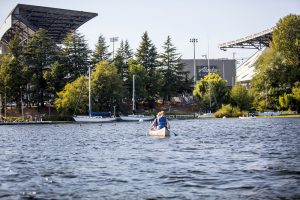
Boating at the WAC

UW employees can learn to sail with the student-run Washington Yacht Club, which operates a fleet of dinghies, catamarans, daysailers, keelboats and windsurfers.

Want to row like the “Boys in the Boat?” Join the Union Bay Rowing Club (UBRC), the UW’s sub-varsity place to learn sweep rowing and sculling. Just across the University Bridge, you’ll find programs for beginners and experts alike at the Pocock Rowing Club, named after Washington’s legendary boat-builder and rowing philosopher George Yeomans Pocock.

Or maybe you’d rather be in the water than on it. You can learn to swim, get in your laps or take an aqua fitness class in the new and daylighted IMA pool. For more adventurous plungers, there are many unsanctioned places to take a dip off various docks and shorelines that wrap around south campus and the UW Botanical Gardens. Just don’t expect any lifeguards. You will find lifeguards — in season — patrolling established beaches at Magnuson Park and Green Lake, among a vast network of King County beaches.

Moments of mindfulness

Sometimes you want to raise your heartbeat. Others, you want to lower it. Tucked here and there amid the everyday hustle of a major university system are countless spots to escape the throngs and take in a moment to reflect, meditate or center yourself.

The Silent Reading Room of the UW Bothell Library offers a vaulted window on the arboreal world outside. Also restorative is a stroll through the century-old Uplands forest, the Chase House Orchard or the North Creek Wetland.

An urban village, UW Tacoma is just a short walk from the green space of Wright Park and the contemplative pedestrian Bridge of Glass, with its thousands of colorful Chihuly works, in the Museum District (or try the Chihuly Room of the UWT Library).
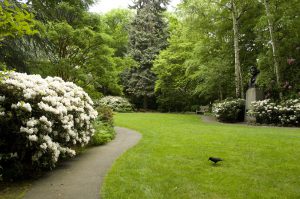
Grieg Garden

UW’s Seattle campus is graced with such untrodden treasures as Sylvan Grove, the pastoral home of the UW’s iconic Ionic columns, the hidden sanctuary of Grieg Garden near the HUB and, just outside its natural green walls, the curiosity of an artistic — and quite inviting — red swing.

Take a seat on a bench or plop down on the lush grass of the Liberal Arts Quad, Denny Yard or Parrington Lawn, which can transform into veritable fortresses of solitude when the usual hustling human highways slow down on summer days.

Further afield, find a shady respite from summer heat in the Yesler Swamp. Escape the madding crowds in any of the Washington Park Arboretum’s exquisite 230 acres (The Japanese GardenRhododendron GlenWoodland Garden and the cathedral-quiet Pinetum are a few favorites).

On a fine day, contemplate the ducks paddling across Drumheller Fountain, the breathtaking view down Rainier Vista, the Grove and meadow on Montlake Cut just behind the UW Medical Center or the aromatics of the UW Medicinal Garden.
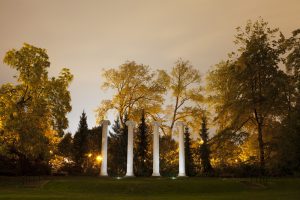
Sylvan Grove and the UW Columns

On a foul day, take scenic cover in PACCAR Hall’s Hogan Terrace overlooking Denny Yard or embark on a botanical tour of the world in the UW Biology Greenhouse (open to the public for free Thursday afternoons).

Whatever the day, you can always find peace and quiet in a network of prayer and meditation spaces located across all three campuses and UW Medicine system.

Contemplate the planet’s rotation at the mesmerizing Foucault pendulum in the Physics Building. Gaze to the heavens inside the James Turrell Skyspace: Light Reign, in the Henry Art Gallery.

And no list of meditative spaces would be complete without the many muffled nooks and quiet crannies across the UW Libraries system. The most iconic, of course, is grand Reading Room in Suzzallo Library, where the gothic hush is often described as downright Hogwartsian.

Accessible movement: Explore the IMA’s adaptive fitness equipment

At the University of Washington, we believe that wellness is for everyone, regardless of abilityThat commitment is on display at the Intramural Activities Building (IMA), where adaptive resources for faculty, staff and students with disabilities have been significantly expanded, enhanced and are consistently being evaluated and ready to expand.

In Autumn 2023, the IMA launched a major upgrade to its adaptive fitness offerings, transforming how inclusive wellness is experienced on campus. One key improvement was the reimagining of the IMA’s designated Adaptive Space. Previously, adaptive equipment was scattered throughout the facility, making access difficult and inconsistent. Recognizing the need for centralized, clearly labeled, and easy-to-use resources, the Fitness Facility Work Team took action.

The result? A thoughtfully curated space where members of the UW community with disabilities can engage in movement and wellness comfortably, confidently, and independently.

A look inside: Accessible equipment at IMA

From cardiovascular training to strength-building, our Adaptive Space features high-quality, disability-accessible equipment. Adaptive equipment adjusts to individual needs, making movement more inclusive. Here’s a sample of what’s available—complete with video links featuring Rec Personal Trainers demonstrating proper use:

  • Cable Crossover Machine – Multi-functional and adjustable for a range of abilities
  • Hand Crank Machine – Upper-body cardio/strength building for those with limited lower-limb mobility
  • NuStep Machine – A favorite for total-body low-impact workouts
  • Rickshaw Machine – Designed for strengthening the upper body, especially for wheelchair users
  • Rowing Machine – Adaptable for seated or supported users
  • SciFit Machine – Ergonomically designed for inclusive upper-body conditioning
  • VitaGlide Machine – A cardio machine tailored for wheelchair accessibility
  • Active Hands Gripping Aids- Help users securely grasp weights or handles

We also have an ADA-accessible pool, featuring a zero-entry ramp (with available pool wheelchair) and a chairlift.

We hope to continue bringing in more adaptive equipment to the facility and are always looking for meaningful improvements and expansions.

Getting started: Tips for newcomers

If you’re living with a disability and unsure how to begin an active lifestyle, the IMA is here to support your journey. Here are a few steps to help you get started:

  1. Talk to your doctor or physical therapist – Get recommendations tailored to your health and mobility needs.
  2. Meet with an IMA Personal Trainer – Our experienced trainers can design a program customized to your goals and abilities.
  3. Request a Facility Tour – Staff are happy to walk you through the space and explain available resources. Email Recinfo@uw.edu to set up a tour!
  4. Plan Your Visit – Avoid peak hours (typically 4:00–8:00 p.m.) for a more relaxed experience.
  5. Explore the Pool and Group Fitness Offerings – Many options are low-impact and welcoming to all. Email Josie at Jvklay@uw.edu to learn more about our pool and accessible locker rooms!
  6. Bring a Friend – Having a workout buddy adds encouragement and fun.

The IMA’s adaptive upgrades reflect the university’s dedication to health and wellness for all.  By providing top tier spaces and expert guidance, the IMA empowers every member of the UW community to move, grow, and thrive—on their own terms.

Ready to explore? Join the IMA and discover how fitness can be adapted for you.