

Huskies show up strong: Winter Games highlights and winners
This winter, over 1,800 UW and UW Medicine staff and faculty stepped up to take part in the Husky Strong Winter Games, a three-week challenge focused on building healthy habits, supporting well-being and connecting with colleagues across campuses and worksites.
Collectively, we fundraised $22,246 dollars for the UW Food Pantries from 1,133 donors. Thank you for your generosity as part of the Winter Games!
Participants earned points each week by focusing on different dimensions of well-being, from physical movement to mindfulness to nutrition. As part of the challenge, participants also received a Fitness Pass offering a full week of free visits to 16 local partner studios, encouraging the UW community to try new ways to move.
Our Opening Ceremony featured an incredible panel of UW Athletics coaches and UW leadership including: Michael Callahan, Head Coach, UW Men’s Rowing, Jamie Clark, Head Coach, UW Men’s Soccer, Jita Pandya Buño, Chief Executive Officer, UW Medical Center, Heather Horn, Vice President for UW Human Resources, Andy Powell, Head Coach, UW Track & Field and Cross Country, and Jen Salling, Assistant Coach, UW Softball & Olympian.
Watch the recording to bring back the energy and inspiration:
Together, our community accomplished some truly impressive milestones.
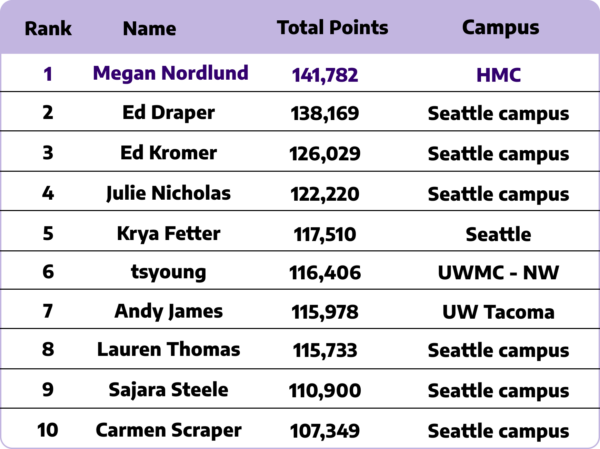
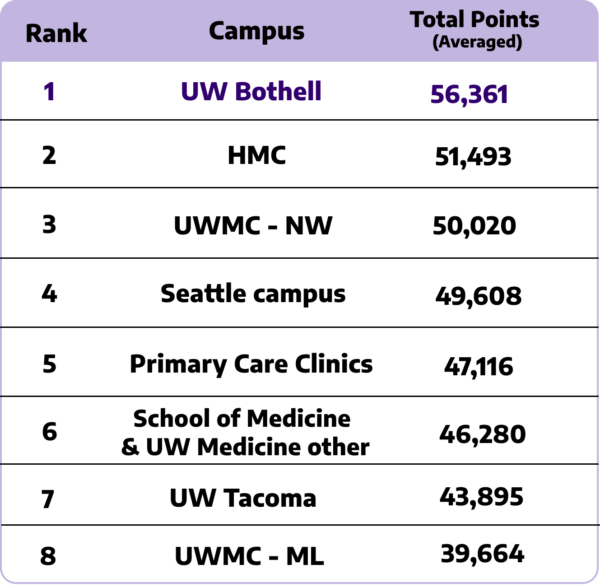
Week 1: Strong Body
Our community kicked off the challenge by getting active and prioritizing movement.
Participants collectively:
- Exercised for 103,734 minutes
- Stretched for 25,788 minutes
- Moved 17,719,630 steps
That’s the equivalent of walking thousands of miles together as a UW community!
Week 2: Centered Mind
In week two, participants shifted their focus to mindfulness, connection and mental well-being.
Together we:
- Mindfully walked for 43,637 minutes (over 727 hours, equivalent to 30 full days!)
- Added mindful moments to 322 UW and UW Medicine meetings
- Gave out over 1,379 compliments
- Meditated for 31,577 minutes (over 526 hours, equivalent to just under 22 days!)
These simple moments of pause and connection helped build a more supportive and mindful workplace across the University.
Week 3: Fueling Well-Being
The final week focused on nutrition and fueling our bodies for health and energy.
Participants reported collectively:
- 1,470 cumulative days of hitting nutrition targets (over 4 years!)
- 1,448 homemade meals
- 256 participants completed a podium of nutrition wins
- 5,822 servings of fruits and vegetables were consumed! (Enough to give nearly 800 people their recommended servings for a week!)
From cooking at home to making healthier choices throughout the day, participants found creative ways to power their well-being through nutrition.
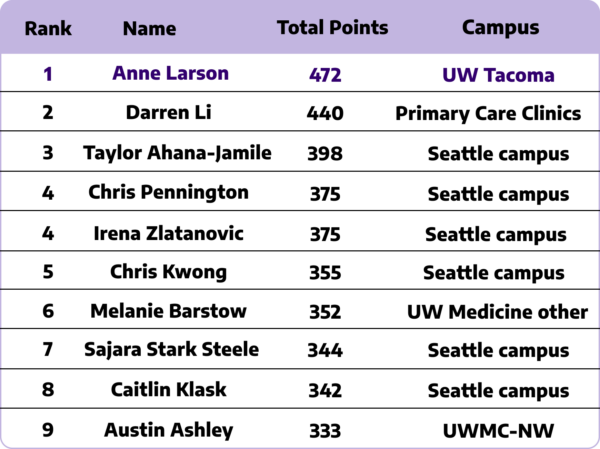
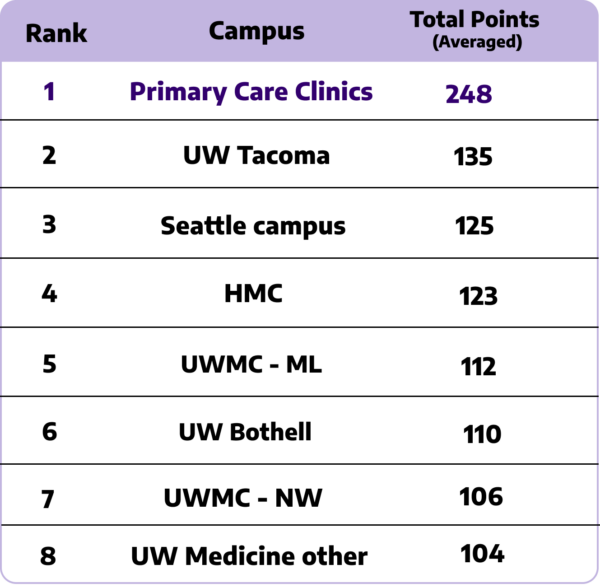
Overall Winners
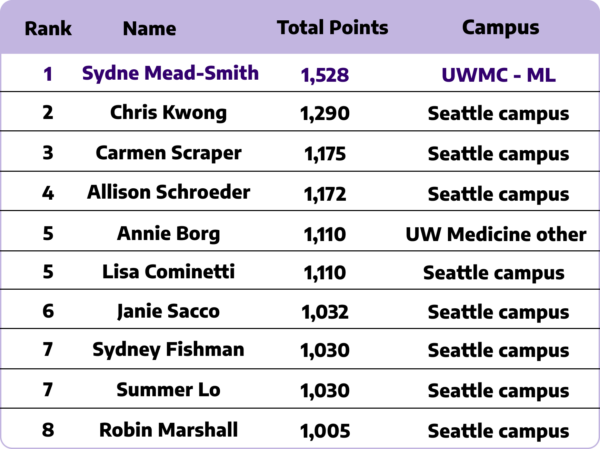
After three weeks of effort, consistency and friendly competition, the final scores are in. Without further ado, our top 10 participants across the entire challenge are:
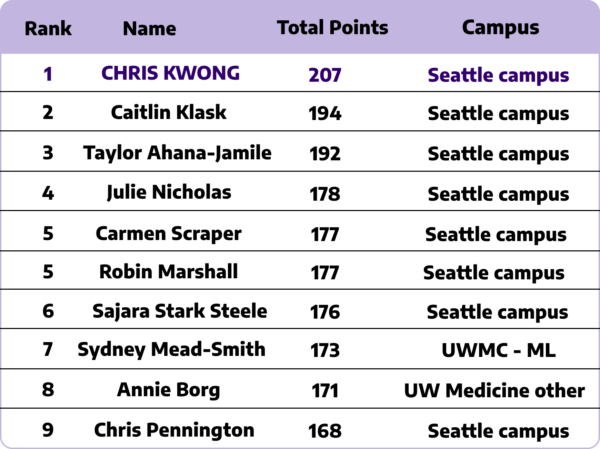
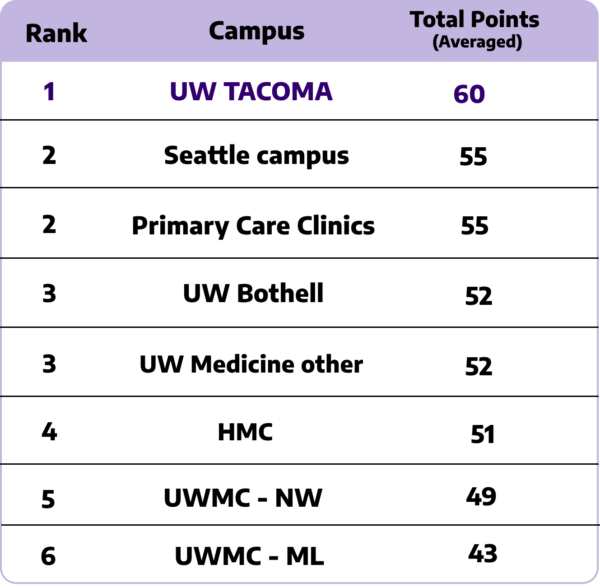
Congratulations to Chris Kwong, who finished at the top of the leaderboard!
Our other top performers mostly work across the Seattle campus, with additional representation from UWMC – Montlake and UW Medicine Human Resources.
Campus Competition
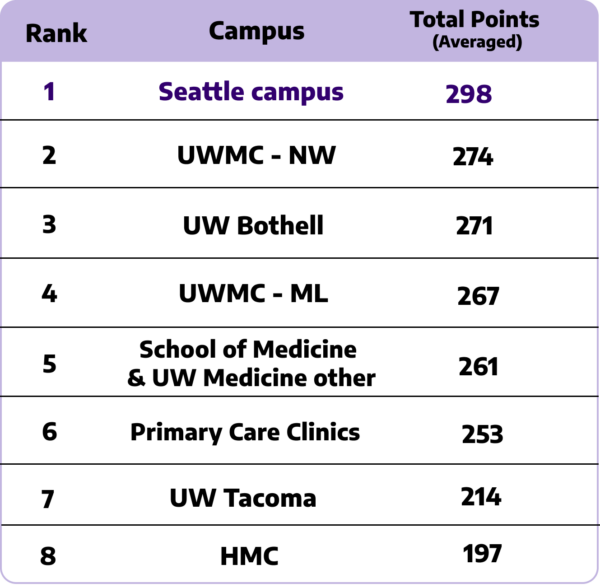
Campuses across the UW community also competed for top honors.
🥇 1st place: UW Tacoma
🥈 2nd place (tie): Seattle campus and Primary Care Clinics
🥉 3rd place (tie): UW Bothell and UW Medicine other / School of MedicineUW Tacoma’s win shows that success in the challenge came down to dedication and consistency, not just team size.
Scoring methodology
To ensure the competition was fair across all three weeks, scores were normalized before calculating the final results. Because each week featured different activities and scoring scales, individual scores were converted to a percentage of that week’s top score.
These normalized scores were then added together so that each week contributed equally to the final standings, regardless of the activity type.
For the campus competition, we averaged the final scores of participants from each campus. This approach ensured campuses of different sizes could compete fairly, rather than larger campuses automatically having an advantage.
Thank you to our sponsors BECU and Husky Mobile for making events like these possible!