Skip to content

How to navigate winter darkness

Happy girl with a red scarf on the winter background

As the light shifts to lower intensity and the weather begins to ebb and flow, we are invited to more skillfully engage with daily life. In the past, human beings were much more attuned to the rhythm and patterns of the natural world, whereas today, while we are still affected by these same natural currents, we tend to be more insulated from what is actually going on. When that is so, it tends to have negative consequences around mood, energy, and overall wellbeing.

The good news is that humans are resilient, adaptable, and—with the right plan in place—can navigate and see clearly through even in the darkest of storms. To stay the course during these next months of winter, consider exploring the following techniques. Don’t worry about engaging them all at once. Pick one or two and notice what shifts. After that, stick with these or start to add one more. Baby steps, lots of compassion, and if you fall off track no big deal, simply begin again.

Move your body

Move your body at least four times a week for 30 to 45 minutes (including some weight training). This will provide more reduced inflammation, lowered blood pressure, increased metabolism & blood circulation, better sexual vitality, enhanced sleep, and increased executive functionality in the brain.

Eat less sugar, more whole foods

Reduce sugar consumption and refined/processed foods. If you do need something sweet, try including more sweet spices in your cooking (cinnamon, cardamom, nutmeg, cloves), sweet veggies (carrots, sweet potatoes/yams, cooked onions, parsnips, etc.), and higher quality sugars (dates, coconut nectar, maple syrup, raw honey), but still in moderation.

Get enough protein

Ensure you are consuming enough protein (from any and all sources that work with your personal nutrition choices, such as fermented soy, legumes, nuts/seeds, low mercury fish, and grass fed animal sources), which means you are also getting ample essential amino acids. Low mood, fatigue, and sleep disruption can correlate to lack of high-quality protein.

Omega 3’s are key

Consume enough omega 3’s from real, whole food sources (try clean non-toxic fish in order to get a broader spectrum of nutrients). If you are vegan, you can use a marine algae omega 3’s which is the only vegetarian source that provides both Eicosapentaenoic acid (EPA) and docosahexaenoic acid (DHA)—together, the backbone of omega 3’s health-giving benefits.

Prioritize winding down

Carve out time to wind down, get enough high-quality sleep, connect with family and friends, and enact self-care rituals for stress reduction (make soup, read a book, walk in nature, walk your legs up the wall, breathe deeply for three minutes, or host a potluck).

Check the chemicals in your life

Do a chemical toxicity inventory of your life (What is off-gassing? What chemicals are you putting on your skin?). Download Thinking Dirty app and scan barcodes of your household products.

Focus on fiber and good gut health

Take care of your gut health by remembering to consume probiotics and prebiotic/fermentable fiber foods such as garlic, leeks, onions, scallions, shallots, artichoke, Jerusalem artichoke, asparagus, bamboo shoot, beets, burdock root, savoy cabbage, cassava, cauliflower, celery, chicory and dandelion root, daikon, fennel bulb, collards, dandelion, kale, mustard, spinach, jicama, mushrooms, okra, butternut squash, sweet potato and yam.

Light makes right

Engage in light therapy to stave off seasonal affective disorder (SAD). Thought to be caused by the effect of reduced natural daylight on brain chemicals that regulate our sleep patterns and mood, SAD can be addressed by exposure to high intensity white fluorescent light (10,000 lux) for approximately 30 minutes a day.

UW’s first NMDP match: Alana Geylani’s life-saving gift

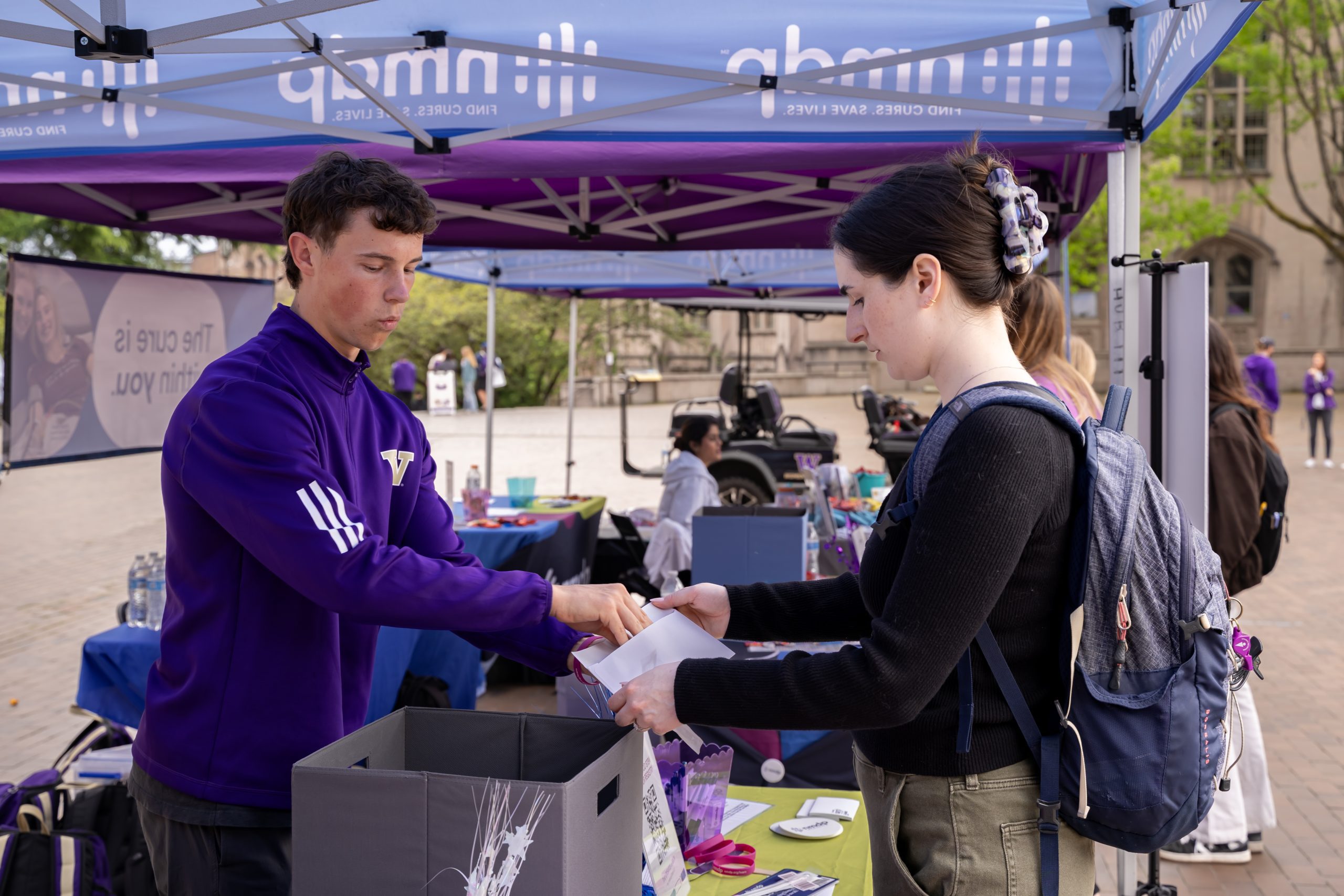
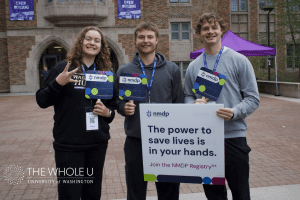
For the past six years, The Whole U has partnered with NMDP (formerly Be The Match) and UW Athletics to host Get in the Game, an annual event encouraging Huskies to join the registry of potential bone marrow and blood stem cell donors. More than 2,000 UW students, staff and faculty have stepped forward over the years, swabbing their cheeks in Red Square and signing up with the hope of one day being called to save a life. 

Alexes Harris and Ed Taylor attend Get in the Game.

This year, that hope became reality. UW has its first confirmed match: sophomore Alana Geylani, who is donating her blood stem cells to help a patient in need. 

A pre-sciences UW student with growing interest in the field of public health, the match couldn’t be more perfect.

Inspiration & First Steps

Alana’s journey began in a class discussion during her freshman year. In her sociology course, Professor Alexes Harris shared her own story of how a bone marrow donation saved her life and gave her the chance to watch her daughter graduate. 

“I tell my students every year that signing up for the registry is one of the simplest, yet most powerful, acts you can do for another person,” said Harris.

“To see Alana take that message to heart and now step forward as UW’s first match—it’s truly inspiring.” 

In that same classroom, Harris also asked students to think critically about health disparities in cancer treatment, especially for people of color. She posed the question: Why are so many underrepresented populations missing from the registry, and what does that mean for patients seeking a match?

Hear more from Alexes Harris in a local King 5 segment:

Getting the Call

For Alana, who was already thinking about her own mother thousands of miles away, the discussion struck a personal chord. She left class determined to take action, and not long after, she signed up on Red Square. 

At the end of July, Alana’s phone rang with unexpected news. She was a near-perfect match for a patient. “At first, I thought it was spam,” Alana admitted with a laugh. “But once I heard the voicemail, I called back right away. I was nervous and speechless, but the moment I learned that I could save someone’s life, I knew I had to do it.” Her decision to say yes came naturally. With a growing passion for public health, Alana saw this as an extraordinary opportunity to make a difference. 

Alana was especially moved by just how close of a match she was. “Knowing my genetic match was nearly identical made the experience feel deeply personal—almost like it was meant to be. Something in me kept saying this was exactly what I needed to do.”

Although privacy rules mean she cannot share details about her recipient’s identity, Alana emphasizes that this person, and their story, remains at the heart of her journey.

Alana during her donation appointment.

Donation Process

Since then, Alana has been busy with clinic visits, phone calls and learning the step-by-step process of donating blood stem cells. She was surprised to learn about the care and logistics involved, from volunteer couriers hand-carrying donations to the strong support system NMDP provides to donors and families.

“They’ve helped with everything—explaining each detail, supporting me emotionally, even helping my cousin travel to be by my side,” Alana shared.

Personal Reflection

For Alana, this experience has only deepened her interest in public health and her appreciation for the power of human connection. 

“Knowing that a part of me could make such a big difference in someone’s life fills me with gratitude and pride,” she said. “Something in my mind just told me this was what I was meant to do.” 

A Message to Others

Alana hopes her story will inspire others at UW to join the registry. 

“Whoever’s out there debating on whether or not to sign up—just think about how impactful this small decision can be,” she said. “It’s a chance to give hope and maybe even a second chance at life.” 

A Wellness Perspective

 “This moment is such a powerful reminder that wellness is not just about physical health, but about connection, purpose, and giving of ourselves,” said Lauren Updyke, Executive Director of Employee Experience and UWHR Chief of Wellness.

“Alana’s generosity shows us that each of us has the ability to make a life-changing impact, and it inspires our whole UW community to consider how we can show up for one another.” 

UW Athletics and Community Support

From the beginning of this partnership, UW Athletics has played a central role in championing the cause. The mission has been especially inspiring to the UW Women’s Soccer team, who shows up in large numbers each year to the Get in the Game event. 

“Alana’s courage and selflessness reflect the very best of our Husky family,” said Head Women’s Soccer Coach Nicole Van Dyke.

“For all of us in UW Athletics, being part of this journey with NMDP and The Whole U fills us with such joy and gratitude. Moments like this remind us what service and community truly mean. We are forever thankful to Alana and to Dr. Harris, whose powerful story continues to inspire our community, and we hope Alana’s example encourages more Huskies to join the registry for a chance to save a life.” 

Nicole Van Dyke and the UW Soccer coaching team at the Get in the Game event.

As UW celebrates its first confirmed match through Get in the Game, the impact of this partnership is clear: every swab is a chance to save a life. And now, thanks to Alana, one patient’s story continues. 

You Can Join Too

Our UW NMDP student organization will be co-hosting an event in Red Square on October 22 and 23 from 10 a.m. to 3 p.m. each day. Stop by the event and follow along with UW NMDP on Instagram. 

UW student athletes and volunteers spread the word.

Get Involved Today

To register, visit join.nmdp.org/UW
or Text UWSAVES to 61474

Special thanks to TIAA for Sponsoring The Whole U and Get in the Game.

Staying safe for fall and winter hiking

As an avid hiker and backpacker, I have experienced the PNW in all its weather elements. I am the Chair of the Mountaineers Foothills Branch Backpacking Committee, Co-Creator and Administrator for a beginning hiking series called GoHike, and an urban walk leader. My emphasis on safety is a priority. I help participants gain confidence, practice leave no trace principles and foster a space for belonging. I welcome all levels of physical abilities and create a community of outdoor enthusiasts who take care of one another on the trails.

The wintry weather is here, and safety essentials are necessary on our trails. We need options for the wet, cold, and snowy trails to recreate on. Snow fans rejoice this time of year because snowshoeing, skiing and snowboarding opportunities abound. But what about the rest of us who just want to get on the trails and hike? While it can be exciting to hike in snow, see animal tracks, and be in awe of frozen waterfalls, lakes and experience the moody, misty wonders of our PNW trails, additional safety measures are essential.

Fortunately, with a little knowledge, prep, and awareness, hiking safely in the colder months is possible.

What can I do to prepare?

Be aware of the conditions of the roads and trails before you go.

Bring a map – dI cannot emphasize how important a map is and knowing how to use it! Check out the smartphone apps Gaia or All Trails to download maps to use offline while hiking. Both have affordable subscription rates. Paper maps are also available at local outdoor retailers. Remember, phones can die, so bring your battery pack and a paper map as a backup.

Know before you go! Check out Washington Trails Association for current trip reports, weather forecasts, current conditions, and parking passes required at trailheads.

Captured by Christina Buckman

What are the essentials for hiking during the fall/winter?

1. Always bring the 10 essentials, regardless of the season!

  • Headlamp/sun protection/first aid/knife/fire starter/shelter (emergency bivy)/extra food, water, and clothes.
  • Consider hiking poles: They help with joint impact and balance.

2. Reduced visibility is often the case in the colder hiking season. Know the forecast, and prepare for it to change.

3. Best practice is to not go alone, but if you do, tell someone where you will be, and when you expect to be back. Providing GPS coordinates of the trailhead you start at is an immense help should you need someone to help in an emergency. GPS coordinates can be obtained on Google Maps by clicking on the location of the trailhead. Copy and paste in the message you send to your emergency contact.

4.Be aware of hypothermia and the signs that could mean trouble.
Never wear cotton. A hiking cardinal rule! If it gets wet in our climate, it will not dry and can cause hypothermia to set in fast. Wear wool or synthetic layers and have extras just in case.

5. Proper footwear.
Unless you are snowshoeing, on skis or boards, hiking on trails may sometimes require strap-on micro-spikes or Yaktrax. They are inexpensive and will give you the added confidence on trails that may be icy or snowy. Make sure to have hiking boots that have good traction and are waterproof, to keep your feet from getting wet. Dry feet are happy feet!

Captured by Christina Buckman

What are other resources for information on hiking and other outdoor adventures?

My go-to is Washington Trails Association– Not only does it have the most comprehensive trail database with search components to cater to your needs, but timely articles, current trip reports and opportunities to give back. We owe a great deal of thanks to those diligent WTA volunteers who spend time on the trail keeping it safe for us.

The Mountaineers – With a myriad of courses, clinics and seminars spanning a variety of activities, the options are endless, and you know you will be well cared for with expert leaders. Scholarships available for memberships and courses.

REI Expert Advice

REI Uncommon Path: Blog

Where can I get inspired?

Instagram can be a great resource for inspiration, without having to read long articles or blog posts. Check out the IG handles I follow below for diversity, inclusivity, body positive profiles, helpful tips, and travel pics for inspiration.

  • Her PNW Life – community of adventurous women in the PNW
  • Issaquah Alps Trails Club – Dedicated to engaging the public to preserve, protect & promote the land, wildlife, and trails.
  • The Mountaineers – Nonprofit, volunteer-led org working to inspire a lifetime of outdoor adventures.
  • Brown Girl Outdoor World – Black, Indigenous and Anti-racist POC 2SLGBTQ+ in the outdoors
  • She Colors Nature
  • Unlikely Hikers – Body liberation and anti-racism outdoors
  • Women Who Hike – Empowering women who hike on and off the trail.

Captured by Christina Buckman

How can I build community?

Having a sense of belonging and community as outdoor enthusiasts is essential, and incredibly rewarding. I highly encourage you to research options where you can meet new people, to learn from and be inspired by one another. My volunteer work with the Mountaineers has been and continues to be, the greatest source of my inspiration. The best part is making lifelong friendships and connections. We are fortunate to live in a state surrounded by water and mountains. Get out there, be safe, have fun, and hike on!


Christina Buckman (she/her) is a UW Alumni and works as an Academic HR Business Partner on the Bothell Campus. As an employee of the University for 11 years, she is proud to be a Husky. As an avid hiker and backpacker, she is a mentor and leader with the Mountaineers, where she focuses on safety, inclusivity, body positive mentorship and makes sure everyone feels a sense of belonging as she shares her passion for the outdoors.


Unlocking personalities: Understanding yourself and others

Have you ever wondered why people think, feel, and behave so differently from one another? 

 In an enlightening webinar titled “Unlocking Personalities,” Dr. Michael Johnson, the Boeing Company Endowed Professor of Business Management, explored how understanding the Big Five personality model can help us better comprehend our own and others’ behavioral patterns.   

The Big Five Personality Dimensions

From Dr. Michael Johnson’s ” Unlocking Personalities: Understanding the Big Five Model” webinar presentation, University of Washington, 2024

Openness to Experience

  • Core Traits: Creative, curious, and receptive to change 
  • Workplace Impact: Excel in roles requiring innovation and creativity 
  • Career Implications: Strong tendency toward artistic and scientific fields 
  • Professional Development: Best suited for roles involving innovation and strategic thinking

Conscientiousness

  • Core Traits: Organized, reliable, and achievement-oriented 
  • Workplace Impact: Strongest predictor of overall job performance 
  • Career Implications: Lower rates of workplace deviance, higher task completion 
  • Professional Development: Excels in roles requiring attention to detail and reliability

Extraversion

  • Core Traits: Sociable, assertive, and energetic 
  • Workplace Impact: Enhanced performance in sales and management roles 
  • Career Implications: Natural tendency toward leadership positions 
  • Professional Development: Thrives in roles requiring interpersonal engagement

Agreeableness

  • Core Traits: Warm, cooperative, and sympathetic 
  • Workplace Impact: Higher levels of organizational citizenship behavior 
  • Career Implications: Strong team collaboration and support capabilities 
  • Professional Development: Best suited for roles requiring interpersonal harmony

Neuroticism (Emotional Stability)

  • Core Traits: Tendency toward emotional variability and stress sensitivity 
  • Workplace Impact: Influences stress management and pressure handling 
  • Career Implications: Affects decision-making under pressure 
  • Professional Development: Benefits from roles with structured support systems 

Using the Big Five Model for Personal and Professional Development

Understanding your Big Five personality profile offers more than just self-insight – it provides a framework for personal growth, professional development, and building better relationships with others.  

Personal Growth 

Self-awareness: Recognizing one’s standing on the Big Five dimensions can lead to greater self-awareness. For example, if you know you are low in conscientiousness, you can focus on developing strategies to improve organization and reliability. Similarly, if you score high in neuroticism, you can work on stress management and emotional regulation techniques. 

Managing Strengths and Weaknesses: Each trait has potential strengths and weaknesses. High scores in a particular trait might lead to beneficial outcomes in certain situations and less so in others. For example, while high extraversion can benefit networking, it might also lead to overstimulation and the need for solitude for some people. Knowing these potential downsides enables you to manage and adapt your behavior effectively. 

Targeted Development: By understanding your personality profile, you can target specific areas for personal development. For example, those low in openness can consciously work on being more receptive to new experiences and ideas. Individuals can consciously work on their behavior and personality, such as becoming warmer or more assertive. 

Interpersonal Relationships  

Understanding Others: Awareness of the Big Five model can help you understand how others think and act. For example, if you interact with someone low in agreeableness, knowing they may “tell it like it is” can help you avoid taking their directness as a personal attack.  

Team Composition: Knowledge of personality traits is helpful in team composition and role assignment. Understanding that agreeable individuals are more likely to engage in organizational citizenship behaviors can help build teams. Placing an individual high in openness in a role that requires innovation can foster creativity.  

Effective Communication: The Big Five can affect communication styles. For instance, extroverts tend to be talkative and assertive, while introverts might prefer to communicate in writing or one-on-one settings. Recognizing these differences can lead to more effective interpersonal communication. 

Leadership: Extraversion strongly correlates with leadership emergence, and those high in this trait tend to be assertive and energetic. On the other hand, high neuroticism can negatively affect leadership effectiveness. Understanding these connections can help you recognize and develop your leadership skills and styles.  

Relationship Dynamics: Agreeableness is linked to increased organizational citizenship behaviors, and agreeable people are warm, cooperative, and sympathetic. However, very high agreeableness can sometimes be seen as naive. Effective interpersonal relations require a balance of agreeableness and assertiveness. Interpersonal traits such as extraversion and agreeableness are linked to cooperation, sensitivity, warmth, and social coordination behaviors. 

UW Resources for Personal Growth and Professional Development

Understanding personality traits is valuable, but putting this knowledge into practice often requires support and guidance. The University of Washington offers two key resources to help you on this journey. The Washington State Employee Assistance Program (WA EAP) provides PEBB-eligible employees and their household members with confidential support, including solution-focused counseling services. You can access up to 3 sessions per concern and use this benefit multiple times throughout the year as different challenges arise. 

For additional support in specific areas of life, UW WorkLife offers valuable resources for managing both personal and professional challenges. Whether you’re seeking guidance on workplace relationships, looking for work-life balance strategies, or needing support for caregiving responsibilities, these programs provide the practical tools and information you need to thrive both at work and in your personal life. All services are confidential and designed to support your overall well-being. 

If you missed the live webinar or would like to review the content, a recording is available on The Whole U’s YouTube:

Looking Forward

Dr. Johnson recommended completing a free Big Five assessment at bigfive-test.com for those interested in learning more about their personality profile. He also suggested further reading, including “Me, Myself, and Us: The Science of Personality and the Art of Well-Being.” by B.R. Little and “Quiet: The Power of Introverts in a World that Can’t Stop Talking.” by Susan Cain. 

Spend wisely for the holidays with tips from BECU

The holiday season is a time for joy, connection, and generosity, but it doesn’t have to be a time for financial stress. Our partners at BECU have shared some practical tips to help you navigate holiday spending while staying on budget.

From creating a detailed holiday budget to finding creative gift ideas, these insights can help you make the most of your resources while spreading holiday cheer. Below are BECU’s top tips for budget-friendly holiday spending:

1. Assess Your Savings

Take a close look at your essential expenses and determine how much you can allocate for holiday spending.

2. Review Your Debt and Credit

Before using credit cards, evaluate your current debt and consider how much you can reasonably afford to repay. Set spending limits—and stick to them.

3. Make a Gift List

List everyone you’re planning to shop for and estimate your spending for each person. Compare the total with your budget and adjust as needed.

4. Give Experiences Instead of Physical Gifts

Create lasting memories with experience-based gifts, like a snowshoeing trip or a paint-and-sip class. You can also explore DIY gift options, but remember to factor in the cost of materials.

Gift cards can be a budget-friendly option, keeping costs predictable. This year, BECU is offering discounted pre-paid cards in partnership with Black Friday promotions.

5. Consider Gift Cards

Another great way to combat inflation is with gift cards. They can keep the cost of gifts down by staying true to the budget, and you won’t have to worry about taxes or shopping around for the best price; it’s a win-win on both sides.

6. Plan for Travel Costs

If you’re traveling, account for expenses like transportation, accommodations, and activities. Plan ahead to avoid surprises.

7. Budget for Last-Minute Gifts

Set aside funds for unexpected expenses, like an unplanned holiday party or last-minute guest. If unused, roll this amount into next year’s holiday budget.

8. Search for the Best Prices

Use tools like CouponCabin, RetailMeNot, and SlickDeals to find deals and promo codes. Compare prices to ensure you’re getting the best value.

9. Factor in Costs for DIY Gifts

While homemade gifts can save money, they come with material costs and take time. Budget for these expenses.

10. Include Charitable Giving

If you plan to donate this season, include charitable contributions in your holiday budget. Consider incorporating donations into your year-round financial plan.

11. Watch Out for Scams

Stay vigilant against phishing scams and copycat websites that could compromise your personal information.

Plan for Next Year

Once the holidays are over, start preparing for next year. Open a separate savings account or envelope, and contribute to it monthly to build your holiday budget gradually.

These tips are shared by BECU and are intended for general financial education. For personalized advice, consult a qualified financial professional.

How to find new hobbies and foster creativity

In the ever-lasting quest for a balanced life, making space for hobbies, passions and creativity can be a pivotal key in finding our equilibrium. Our hobbies are an important way to express our creativity and to explore who we are. They can also bring challenges, a sense of accomplishment, and an opportunity to connect with others. In fact, creativity is central to human activity and thought. It has been the driving force for all innovation throughout human history.

But with the energetic drain of our daily responsibilities, it is easy to neglect space for creativity and hobbies. We need this space in order to thrive. If we are looking to change our lives and find joy in the moments between the monotonous day-to-day responsibilities, putting effort into a new hobby might be just the thing for you. As the saying goes, “You are never too old and it is never too late.”

Start by following your feelings

It can be hard to find a new hobby if you have not already invested years into one, especially as an adult. Where can one start? One of the first steps into exploring new hobbies and passions is to follow your feelings! Listen to yourself, your reactions to activities you are already doing, and bring awareness to your feelings during your experiences. Try asking yourself these questions as you explore:

  • Where do you find joy?
  • Where do you find peace?
  • What do you value?
  • What are you interested in?
  • What are some activities that you currently do that allow you to seem to lose track of time?
  • Take some time to reflect (maybe even start a journal) and ask yourself these questions. As you take the time to answer these questions, take this as an opportunity to explore and get to know yourself better!

Revisit your inner-child

It’s been said that the child-versions of ourselves are the most authentic version of ourselves. As you dive deeper into your self-exploration, ask yourself what you enjoyed as a child. Revisit these experiences and see how you feel. Were you always playing outside? Try exploring a hobby that will take you out in nature. Did you enjoy being active and playing sports? Try joining a team sport. Were books in quiet corners more of your thing? You might find joy in a book club or with a writing group. As you take this journey to your hobbies, you may find a path leading you to your most authentic self.

Create a space for creativity

Once you’ve found a hobby you are interested in, create space. Literally and figuratively. Set a dedicated time in your week to immerse yourself completely in this your hobby. Most of us have been taught that when it comes to time, productivity is what matters most. As a result, we’ve structured our lives around work rather than play. But with a little thought, you should be able to find more time in your schedule to do the things you love.

If you are taking up a new hobby that can be done from your home, set up a dedicated space. A workshop, music room, art space, etc… You’ll find that having this space already set up and committed to your craft will help you stay consistent in your practice. Think of this like a meditation. You won’t be able to experience the full joy and wonder of your craft unless you stay committed to the practice.

Patience and Process, Not Productivity

Your hobby is not about producing or presenting something for others. This is your craft. Your practice.  Allow yourself to get lost in the highs and lows of immersing yourself in a practice, without the attachment to leave something behind. Try to put aside the strange pressure we feel to “prove” ourselves and simply do to do. Create to create, then, watch yourself grow along the process.

Looking for somewhere to start?

See if the following free, creative classes with The Whole U interest you. You may strike a new passion! Follow along on YouTube.

History of Japanese Origami Workshop with Guided Creation

Origami is the art of paper folding and a traditional Japanese culture. This workshop will introduce the background of the origami culture and also give guided instruction in creating origami. In the first half, the presenters will talk about several topics: the history of origami, its symbolism of peace, applications in science and industry, and other benefits. In the second half, the presenters will show some examples and give guided instructions for those wishing to try it themselves.

Art Series with Miha Sarani 

Do you have an appreciation for the arts? This virtual workshop series with Mihai Sarani explores:

Learn more about various forms of art and have fun trying something new with UW alum Miha Sarani, visual artist, art historian, and art educator. These workshops are appropriate for all ages.

Intuitive Painting Workshop with Studio Life 

Join Studio Life and instructor Lotte Goede for a time of spontaneous painting by tapping into our creative intuition. No experience necessary! You will quiet the minds, connect within and paint from intuition. This workshop is about creative exploration and freedom – a process of letting go and joyful discovery in a non-judgmental space.

There are no mistakes here. You’ll be transforming your canvas with every layer, which in turn will inspire your next step.

Watercolor Painting Class with Sarah Simon of TheMintGardener 

Join Studio Life and watercolor expert Sarah Simon of The Mint Gardener for a watercolor painting workshop. During this 90-minute workshop, Sarah will share how she has been able to expand her creativity through watercolor painting and starting her business The Mint Gardener. Sarah will then instruct a leaves and florals watercolor painting workshop.

All levels are welcome!


Wherever you are in your creative journey, The Whole U is here to help you stay on track with your goals and connect you to exciting, new opportunities. Share with us what forms of creativity you love or have found in the last year in the comments below!

Password phishing scams: How to avoid them

Learn how you can protect yourself from the fake alerts and emotional plays scammers use to steal your passwords with this thorough guide from our partners at BECU.


 Takeaways: Common phishing tactics and how to avoid them

  • Password phishing is when scammers posing as legitimate organizations contact you (usually about a fake urgent problem), to steal your passwords and access to your accounts.
  • Common password phishing tactics include messages about fake password resets, fake package delivery issues, fake prizes, fake fraud alerts and fake charities during real disasters.
  • Phishing is a widespread problem and can lead to a loss of access to bank and personal accounts, fraudulent credit card charges, and fake social media posts.
  • Some ways to protect your money and identity include using a password manager, choosing a password that is at least 15 characters, employing hard-to-guess security questions and enrolling in multi-factor authentication.

What are password phishing scams and how do they work?

Password phishing involves scammers using any method of communication — often about a fake urgent problem that seems to require your immediate attention — to steal passwords to your banking, credit card, health care or entertainment accounts, or trick you into giving your passwords away.

Scammers often pose as people or organizations you’ve interacted with or that sound official, such as businesses, government organizations and trusted service providers. They might contact you through emails, phone calls, voicemails, text messages or social media with an offer that sounds too good to pass up, or a threat to discontinue a service you rely on if you don’t respond right away.

The scammers’ message often contains a link. This link prompts you to enter your username, password or authentication code, or it will launch malicious software giving scammers access to your login information.

Scammers then use this information in a few ways:

  • Stealing money from your bank or credit union account.
  • Stealing your personal or corporate files and photos.
  • Making fake social media posts to scam others.
  • Impersonating you by email or in other ways to target your family and friends for scams.

If scammers contact you by phone, they often try to convince you to give them account information, authentication codes or credit card details. If your credit card is involved, the scammer might run up charges on your card.


Common password phishing scams and tips to protect yourself

Here are a few common methods scammers use to steal your personal information and some tips to help you protect yourself.

Fake password resets

Fake password reset messages are when a scammer calls you or sends a phishing email or text telling you that you must reset your password or provide information to verify your account. The messages often pretend to come from big brands such as Microsoft, or social media platforms like Facebook.

These types of attacks aren’t new, but they continue to be common because they are so successful.

In one scam, business executives were targeted with phishing emails that appeared to be from Office 365. The emails said the account passwords were set to expire. Users unknowingly entered their login credentials, which hackers could sell and use to send out more phishing emails.

How to protect yourself:

  • Never give passwords or authentication codes to callers.
  • Only reset your password if you initiated the reset. Companies typically won’t email you links to reset your password without you requesting it.
  • When in doubt about a password reset, go directly to the website, not through the email or text link, and reset your password there.
  • Look carefully at the email address of the sender. Make sure it’s spelled correctly. Hover your mouse over the email to make sure the address that pops up is the same as the address you see in the sender field.

Fake package tracking alerts (text or email)

In this type of phishing or smishing (SMS phishing) scam, attackers send email or text alerts claiming to have tracking information about a package, or that a package is waiting to be delivered.

The scammers say they will provide the package information after you enter personal information or make a payment. Usually, the message tries to lure you into disclosing your username and password, or credit card number.

In other cases, the scammers will try to convince you to click on a link that installs malware.

The U.S. Postal Service Office of Inspector General alerted postal service customers in which scammers sent phishing messages claiming to have postal tracking information about packages. FedEx and UPS have also cautioned their customers about these scams.

How to protect yourself:

  • Watch out for this type of scam as the holiday shopping and shipping season approaches.
  • Verify links in text and email messages match the web address of the package carrier service.
  • If you’re not sure about a messenger or sender, don’t click any link sent to you. Instead, open a new browser window, log in directly to the website and enter your tracking number there.

Fake rebates and prizes

Prizes, refunds and rebates can be hard to resist. In one type of phishing attack, scammers send phony text messages. These messages offer to send you money if you click a link where you’ll be prompted to log in or enter your banking information.

These messages might tell you the offer is for a limited time only, creating a sense of urgency.

A few fake prize scams have pretended to be from Hulu, Verizon and AT&T.

How to protect yourself:

  • Assume that if a prize is too good to be true, it probably is.
  • Pause for a moment, especially if you have to “act now” to get money deposited into your account. Most reputable companies give plenty of time to communicate a special offer or discount, and they won’t ask you to log in and provide your account number.
  • Look closely at links before you click on them. Make sure there are no spelling errors, and the links match the company website.
  • When in doubt, go straight to the website and see if the special offer or contest is advertised there.

Fraud alert phishing attacks

In a fraud alert phishing scam, scammers impersonate financial institutions or credit card companies with text alerts about fake fraud attempts. These types of scams play on the fear of exactly what the scammers are trying to do: Gain illegal access to your accounts and drain your funds.

Scammers have targeted BECU members with this type of phishing scam.

How to protect yourself:

  • Never provide your online banking user ID or password. A legitimate credit union or bank won’t ask for this information via text, email or by phone.
  • Don’t click links in text messages to respond to a fraud alert. Financial institutions won’t ask you to log in from a text.
  • Contact your financial institution about any fraud alerts or threats to your account using a legitimate phone number that you look up on their official website or on your debit or credit card, or contact them through your online account.

Disaster phishing attacks

Scammers prey on vulnerable people during widely publicized hard times, posing as government agencies and fake charities during natural disasters and other crises.

Following catastrophic flooding in Texas, scammers posed as government employees and charities to steal money and personal information. Others have demanded money in exchange for information about missing loved ones.

Don’t take the bait. These are attempts to gain access to your personal information.

How to protect yourself:

  • Check websites such as Charity Watch and GuideStar to verify any charitable organizations.
  • Beware of messages that prompt you to apply for insurance or tax benefits. For stimulus payments and tax credits, the first step, if you’re eligible, is to file your taxes. Don’t respond to email or text messages soliciting donations.

Unsecured public Wi-Fi

Heading to the local coffee shop to get a little work done on your laptop seems convenient, but if you’re using an unsecured WiFi network, you’re leaving yourself vulnerable.

Scammers can intercept data as it moves between your computer and the wireless network, which is called a “man-in-the-middle” attack. If they manage to intercept your user name or password over an unencrypted channel, they might use that information to target you with phishing attempts, use your account to send phishing messages to others, or gain access to your accounts directly.

How to protect yourself:

  • Never enter banking passwords or sensitive information over unencrypted public Wi-Fi.
  • Disconnect your Bluetooth if you’re not using it.
  • Don’t shop online on an unsecured network. Attackers can potentially intercept your login credentials for the site you’re shopping on and access your payment information.
  • Use a VPN (virtual private network) to create a secure connection through an unsecured, public Wi-Fi.

4 Tips to protect against password scams

Although attackers are finding new and creative ways to steal your personal data, there are a few steps you can take to improve your overall security online.

1. Use a password manager

Using a password manager that generates random passwords can simplify the task and likely do a better job of keeping your accounts safe than you can on your own.

PCMag has reviews of password managers in several categories.

If you decide to manage your passwords without a service, be sure to create strong passwords and change them frequently. Never use the same password on multiple accounts; if it’s compromised in one account, all of your accounts become vulnerable.

2. Choose a longer password

The safest passwords are at least 15 characters long, according to the latest guidance by the National Institute of Standards and Technology.

The more characters you have, the harder it is to guess. In fact, it would take a modern laptop more than 500 years to work through all the possible combinations of a 15-character password, according to NIST.

If you’re concerned about remembering a long password, consider using a passphrase — combining several real words together.

You can include numbers and special characters to make the password harder to guess, a long password is a higher priority than a complex one, according to the latest NIST recommendations.

Only respond to password change messages if you initiated them. Remember that legitimate organizations won’t send you texts or emails, and they won’t call you to ask you for this information.

If someone calls you asking for the authentication code you just received to help you log in, don’t give it to them. It’s likely a scammer who has intercepted your data.

3. Use hard-to-guess security questions

As a secondary layer of protection, many websites require you to choose security questions and answers.

WIRED magazine calls security questions “problematic” and a “weak link” because the answers are too easy for scammers to guess.

If you are required to rely on security questions, choose questions that can’t be easily answered by a Google search.

If you’re having trouble finding a security question that doesn’t have an easy-to-discover answer, WIRED recommends against answering the security question honestly.

4. Use multi-factor authentication

Multi-factor authentication is a security feature that requires you to verify your identity at least two different ways when you login to an account. Often, you’ll enter your user name and password, then the website or app will send you a unique security code by text message, email or phone call.

This is an important added layer of security, but like all security measures, it’s still subject to hacks and scams. For example, scammers might use bots to convince you to give them your authentication code so they can access your accounts.

How To protect yourself:

  • Only enter codes for accounts you are actively trying to access.
  • Consider it a red flag if you receive a message or a call asking for your code to resolve a problem, especially if there is a sense of urgency.
  • Don’t click any links in the message.
  • Use contact information you have saved, or look it up yourself, to reach out to the organization and check your accounts.

Portrait of Katie J. Skipper

Katie J. Skipper(She, Her, Hers)
BECU Community Content Manager
Katie manages the BECU Blog and writes about personal finance topics including credit cards, budgeting, debt management, loans, taxes, home improvement, inflation, fraud and scams. She also writes about race, gender and social equity, and features the stories and expertise of BECU employees and community members.

A former journalist, she has reported for daily newspapers in Washington and Montana, including The Daily (Everett) HeraldGreat Falls (Montana) Tribune and The Bellingham Herald, covering a range of topics including government, law and justice, and the environment.


Thank you to BECU for sponsoring The Whole U!

5 reasons to visit the dentist

We all know we’re supposed to visit the dentist every six months, but it can easily drop off the to-do list. Add in a global pandemic, and not surprisingly many of us have fallen behind in our regular visits.

Making the time to see a dentist is an important way to take care of yourself. To motivate you to get back into the dentist chair, here are our top 5 reasons it really IS important to visit the dentist, courtesy of the expert faculty dentists at the UW Dentistry Faculty Dental Practice at the UW Campus Dental Center.

Keep small problems, from becoming big problems.

There’s a lot going on in your mouth that you can’t necessarily see.  A bit of decay between your teeth, tartar hiding just below your gum line, an impacted wisdom tooth.  Regular visits ensure small problems are monitored and addressed, rather than becoming larger issues later. A small, early cavity might be treated without drilling and filling, and treating gum disease now will help prevent future tooth loss. That’s something to smile about!

Oral health care is closely related to general health.

Time and time again, poor oral health is correlated with poor outcomes related to several general health conditions.  We know improving your oral health makes you a healthier person overall.  In addition, serious oral problems like cancers are detected by dentists, and early detection ensures the best prognosis and least invasive treatment.

Maintain a high quality of life.

If you’re in pain or simply uncomfortable or embarrassed with your smile, your quality of life suffers. Regular dental visits help safeguard your ability to smile, speak, and eat, by addressing issues of function or aesthetics, while ensuring healthy teeth and gums stay that way. 

Enjoy your food.

It’s difficult to enjoy the food and drinks you love when something in your mouth hurts. Instead of limiting what you eat, chewing food on one side of your mouth, or some other behavior that avoids pain, talk to your dentist!  Common issues like heat and cold sensitivity and general tooth pain can easily be addressed.  Dentists can treat these common conditions and get you back to enjoying the food you love.

Preventative care saves you money.

If your health isn’t enough of a reason to make your oral health a priority, consider the financial benefit.  Regular preventative care and other dental treatment is likely covered by your insurance and seeing your provider regularly means potential problems will be detected early.  By catching issues early, you’ll avoid more costly and invasive treatments later. More money in your pocket!

Looking for a dentist?  The UW Dentistry Faculty Dental Practice is close and on campus. Schedule an appointment with our expert dentists at 206-685-8258 or uwdentists@uw.edu.

Communicating respectfully with people of all gender expressions

Gender diversity has existed throughout time and across cultures. However, in many western cultures we have been socialized to treat gender as binary, only recognizing men and women.

In this context, understanding what gender-inclusive language is and how to use it can be confusing: it’s not typically something we learn in school, it’s constantly evolving, and people’s preferences for defining their identity can vary widely and change over time.

Nonetheless, to create a more inclusive society, we should aspire toward language use that is respectful of all gender identities and reduce our use of gendered language when it isn’t necessary.

And, like any new habit, particularly one that rejects cisnormativity (the assumption that each person’s gender identity fits the binary and corresponds to the sex they were assigned at birth), incorporating inclusive language takes time and practice.

Language, whether spoken or written, is the primary filter through which most of us perceive and experience the world, and it deeply affects how we relate to and understand one another. The words that we use to describe others are often unintentionally rooted in implicit cultural biases, including biases that privilege the gender binary.

Moreover, according to the LGBTQ+ resource center at the University of Wisconsin, all of the professional associations for psychology and psychiatry in the U.S. acknowledge that inclusive language dramatically reduces experiences of depression, social anxiety, suicidal ideation, and other negative mental health factors among LGBTQ+ youth and adults.

“Being non-binary for me means existing in a world that was not built for me,” said Lauren Lichty (they/them), associate professor in the School of Interdisciplinary Arts & Sciences at UW Bothell and co-chair of the UW Faculty Council on Gender Equity and Justice.

“It means experiencing chronic misgendering, in my professional and personal life,” they continued. “Every time I enter a room, I wonder what experience I’ll have related to my identity and brace myself for misgendering. I hope someday that is no longer true. The energy it takes to decide when to correct people and when to accept misgendering- it’s exhausting and alienating.”

“However, when people get my pronouns right, or when they get it wrong and then quickly correct themselves, it’s like being washed over with warmth. I can breathe easier and feel a shift in my sense of worth and belonging.”

Understanding terms

It is easy to inadvertently confuse the terms gender with sex or sexual orientation. Gender is the cultural expression of being masculine, feminine, or any combination or absence of those concepts. Sex is the set of biological markers present at birth, including genitals, reproductive organs and chromosomes. Sexual orientation refers to which genders a person is physically, emotionally or romantically attracted to.

There are several common terms that people often use when discussing gender, as defined by the National Council of Teachers of English:

  • Gender identity: an individual’s feeling about, relationship with, and understanding of gender as it pertains to their sense of self. An individual’s gender identity may or may not be related to the sex that individual was assigned at birth.
  • Gender expression: external presentation of one’s gender identity, often through behavior, clothing, haircut, or voice, which may or may not conform to socially defined behaviors and characteristics.
  • Gender binary: a conceptual framework that defines gender as consisting solely of two categories (termed “woman” and “man”) that are biologically based (“female” and “male”) and unchangeable, and that misrepresents human biological variation and denies the existence of nonbinary variations of gender.
  • Cisgender: of or relating to a person whose gender identity corresponds with the sex they were assigned at birth.
  • Transgender: of or relating to a person whose gender identity differs from the sex they were assigned at birth. This umbrella term may refer to someone whose gender identity is woman or man, or to someone whose gender identity is nonbinary.
  • Nonbinary: of or relating to a person who does not identify, or identify solely, as either a woman or a man. More specifically:
    • Gender fluid: of or relating to individuals whose identity shifts among genders. This term overlaps with terms such as genderqueer and bigender, implying movement among gender identities and/or presentations.
    • Agender: of or relating to a person who does not identify with any gender, or who identifies as neutral or genderless.

What’s up with pronouns?

Pronouns, which are words that refer to people by replacing proper nouns like names, are getting a lot of attention these days. Some pronouns are commonly associated with a specific gender category (e.g., he for men and she for women) and some pronouns are not (e.g., they/them/theirs). You might also hear less common gender neutral pronouns such as zie/zim/zir, sie/sie/hir and per/per/pers.

Pronouns specifically refer to the person you are talking about. Each person gets to determine which pronouns are right for them. For some people those may stay the same their entire life. For other people they may change over time, by day, or depending on the setting they are in. Just like you can’t know someone’s name without asking them, you can’t know their pronouns either.

Often, the easiest way to ask for someone’s pronouns is to share your own pronouns first. You can just say “Hi, my name is Nicole, and my pronouns are she/her/hers. What are your name and pronouns?”

In English we have two words to refer to people that are used as both singular and plural: you and they. There was a period in history where people tried to make “they” plural only, but in recent years they has been officially recognized as correct by the Associated Press, principally in the singular. In fact, you probably already use it in everyday speech, as in “I had a 10 a.m. meeting with a client but they had to cancel.”

It’s okay to not know; it’s okay to mess up. What we need is not perfection, but instead a commitment to participate in a culture where we choose humility, care, and compassion, and where we keep trying to do right by each other.
-Lauren Lichty

Pronouns are a part of everyday conversation, and using them correctly is a way to affirm and respect identity in your interactions that has a direct impact on people’s well-being and sense of belonging.

On the other hand, repeatedly using the wrong pronouns to address or refer to someone is known as a microaggression. When someone is addressed or referred to by the wrong pronoun—particularly intentionally—it can make them feel disrespected, invalidated or alienated.

“The ask here isn’t for people to understand every nuance of the trans and non-binary experience,” Lichty said. “If you struggle to relate to why pronouns matter, that’s okay! Consider shifting your perspective. You don’t need to understand my needs in order to treat me with dignity.”

Slipped up on someone’s pronoun? Don’t worry. If it just happened, say something like “Sorry, I meant (insert pronoun)” and leave it at that. And do this even if the person is not present but others are.

In addition to conversation, you also need to pay attention to gendered language in writing, especially in policies and other organizational documents. At UW, the Rules Office began removing gendered language from policy documents on a rolling basis five years ago, and the Faculty Senate is currently reviewing legislation to remove the remaining approximately 80 instances of gender-exclusionary language in the Faculty Code.

Learn more about the rationale and principles for revising policy language.

Practicing inclusive language

There are many adjustments you can make to your everyday spoken and written language use that will allow your friends, colleagues and relatives of all gender identities to feel included, welcome and safe.

First, avoid making assumptions about gender identity: Most of us have been socialized to attribute gender to people based on how they look, act, or the name they use. Often this happens unconsciously. So our first task is to work on noticing when we are assuming gender. Once we notice, we can gently adjust our thought process by reminding ourselves we can’t know someone’s gender by looking at them.

Practice shifting  your thoughts and speech to use gender neutral language until you know how someone would like to be addressed. And remember, it takes time for these changes to become a habit.

Refrain from defaulting to “-man” in descriptors, using postal worker for postman, sales person for salesman, firefighter for fireman and so on.

To avoid erasing women and nonbinary people from the conversation, try these gender-neutral expressions:

  • Humankind instead of mankind
  • Members of Congress instead of congressmen
  • Councilperson instead of councilman/councilwoman
  • First-year student, frosh, or the British term “fresher” instead of freshman
  • Machine-made, synthetic, or artificial instead of man-made
  • Parent or pibling instead of mother/father
  • Child instead of son/daughter and kiddo instead of boy/girl
  • Sibling instead of sister/brother, Nibling instead of niece/nephew
  • Partner, significant other, or spouse instead of girlfriend/boyfriend or wife/husband
  • Server instead of waiter/waitress, flight attendant instead of stewardess

Referring to a group? Use folks, folx, people, everybody, everyone, colleagues, y’all, friends, or attendees instead of ladies and gentlemen or you guys.

Inclusive acronyms for the range of minoritized sexual and gender identities include LGBTQ+ and LGBTQIA+. It’s OK to use either, but in writing, keep usage accurate to the source.

Proceed with caution

Deadnames—referring to a transgender or non-binary person by a name they used prior to transitioning, such as their birth name, is called deadnaming. If you knew the person by their deadname, it can take some practice to consistently use their new name, but endeavoring to do so acknowledges and affirms their identity.

Like misgendering, intentional deadnaming is a microaggression.

“Preferred” pronouns: While pronouns aren’t the same thing as someone’s gender identity, the way we talk about pronouns can send messages about the ways we think about gender. The word “preferred” suggests that gender identity is a choice and a preference. It also may suggest that it is okay to use pronouns other than the ones a person shares because it’s “just a preference.” Each person gets to select the pronouns they want used, and we need to use them correctly.

Tranny/trannie/transsexual/shemale are derogatory and have been used as slurs, although some transgender people choose to use them. Only use these terms if you are asked to do so.

Transgendered suggests that being transgender is something that is done to change a person or that a transition is required. Use transgender instead.

Two-Spirit (2S) refers to a term intentionally introduced by Indigenous people in 1990 to educate nonindigenous people about the many different sexual and gender identities that fall under the Two-Spirit “umbrella” of each North American native nation’s beliefs. It is not appropriate for cisgender and/or nonindigenous people to use the term.

Additional resources

Get up, stand up: Combatting “Sitting Disease”

Sitting is something so commonplace we often don’t realize just how much of our day is truly spent sedentary. However, sitting for too long can have many negative impacts on health and longevity. A 2011 study in the American Journal of Preventative Medicine found that prolonged sitting was associated with an increased risk of 34 chronic diseases including obesity, diabetes, cancer, and cardiovascular disease. Yikes!

A typical American is sedentary for 21 hours out of the day. Including exercise and physical activity, people across the U.S. only spend approximately 3 hours out of the day simply standing.

This phenomenon has been coined as “Sitting Disease,” which, broadly speaking, is defined as a condition of increased sedentary behavior associated with adverse health effects. Sedentary behavior can be defined by two things: the position you are in, which is generally reclining or sitting, and the amount of energy expenditure that your body is experiencing.

You may be asking yourself, “But I work out every day, does this still apply to me?”

Unfortunately, according to The Journal of Medicine and Science in Sports and Exercise, the “Active Couch Potato” phenomenon states that even an active person who works out five times a week still faces the risks associated with “Sitting Disease” if they are living a sedentary lifestyle outside of the gym. Unfortunately, you can’t undo eight plus hours of sitting with a workout!

Although participating in moderate to vigorous exercise 3-5 times a week is recommended, it’s important to start with the first step: standing. Dr. Brian Liem, MD, FAAPMR, from UW Sports Medicine, says that a “lifestyle of prolonged sitting is distinctly different even from a lifestyle absent of routine exercise.”

A study at Mayo Clinic found that for every 2 hours spent sitting 352 calories are conserved as compared to someone standing. Dr. Liem emphasizes that “standing can help get some of that metabolic activity back up because standing causes contractions in your postural muscles in your back, hips, and knees to keep you upright.”

The majority of Americans stare at a computer screen during the day, whether it be at an office desk or at home. If not, we are looking at the computer in our pockets – our smartphones. An average office worker sits for 15 hours every day, which calculates to about 80,000 hours spent sitting over a lifetime.

Technology has become an accepted part of our everyday lives, but that doesn’t mean we shouldn’t be cognizant of what our bodies are doing while we are using technology.

Staring at your computer with poor posture causes the development of a hump at the top of your back, the shortening of your hip flexors, shortened abdominal muscles, a caving chest, weakened shoulders, arm pain, numbness and tingling in your extremities, and worst of all, traumatic pressure on the disks in your back. All of these symptoms are not uncommon.

Good posture is also important when using a smartphone because a human head weighs about 10–12 lbs. Studies show that bending your head down to the 60-degree typical texting position can make your head weigh about 60 lbs. We spend about 700 – 1,400 hours on our smartphones every year, so putting that much stress on our necks and spines just by bending our heads for that long can start to develop problems.

So, what are some solutions?

We know that it is difficult to be removed from technology and that many common solutions can be expensive or difficult to find on the market. Instead, we emphasize the importance of awareness in terms of your posture, bodily movement, and the amount of sitting/reclining per day.

For every hour of sitting, try to get about ten minutes of standing in. For every 30 minutes that you are doing work, there should be 20 minutes of actual computer work, and then a 10-minute break. That 10-minute break should be 8 minutes of standing and 2 minutes of stretching. This alone is a pretty big change from sitting for hours on end, and should over time give back to your body exponentially.

Incorporate movement breaks into your day

Check out the Whole U’s Flex at your Desk and Stretch at your Desk handouts to learn a few movements that you could try at work. We also encourage you to join The Whole U’s daily movement class at 11 a.m. 15-minutes of stretching and light movement to give your body a much needed sitting break.

When you are sitting, think of an ergonomic posture – bringing your keyboard and mouse closer to your body, keeping your shoulder blades pulled back, relaxing your elbows by your side, and maintaining a neutral spine. The Whole U’s Working with Better Posture handout is a great place to start.

Learn more by watching 2 recorded webinars

Working Ergonomics with Dr. Peter Johnson

Join Dr. Peter Johnson, Professor Emeritus, Environmental and Occupational Health Sciences, and Adjunct Professor of Industrial and Systems Engineering to learn everything you need to know about creating an ergonomic workspace—wherever you’re working! Click here to download Dr. Johnson’s updated slides. 

Sitting Disease Deep Dive with UW Sports Medicine

Elliot O’Connor, DPT, and Dr. Brian Liem from UW Sports Medicine share information about what sitting disease is, how it can lead to chronic back and neck pain, and provide some simple exercises that you can do to prevent and beat the sitting disease.

Small steps can make a big difference – literally!

You can also combat “Sitting Disease” through small things. Try parking farther away, standing while you eat lunch, and doing one-leg balance stances while you watch television or brush your teeth. Every little step you take is one less moment spent sitting.

Alongside standing, aerobic exercise is extremely important. As recommended by the HSS, you should be performing a minimum of 30 minutes of moderate intensity aerobic activity about 5 days a week or 20 minutes of vigorous intensity aerobic activity about 3 days a week.

Top 10 ways to properly fuel your body

Nutrition trends can have a major influence on us as we navigate our overall health and performance. We are eager to try the latest nutrition trend that shows up on our social media feeds or the newest supplement or diet that claims to be life changing.

That’s why we asked Judy Simon, UWMC dietitian, about fad diets and trendy supplements. She had three common observations:

  1. They are not sustainable in the long term
  2. They can be very expensive, and
  3. They often lack the varied nutrients our bodies need.

But Simon is seeing at least one positive nutritional trend: a tendency toward eating more plant-based or plant-forward meals—for both health and sustainability.

“You don’t have to be strictly vegetarian to gain the benefits of a plant-forward diet,” she says. “More fiber improves gut health. Optimizing gut health not only helps people feel better now, it also contributes to preventing and managing many chronic diseases. It’s exciting to see a trend towards more fruits, vegetables and whole grains.”

Simon advises making small changes that will have a big cumulative impact on your overall health over time. Being more mindful here and there about the food we eat can set the groundwork for other sustainable wellness goals while helping us feel energized and ready to take on the day.

She adds that the secret to a healthy, balanced diet is really no secret at all. It is simply understanding your body’s needs and finding what works for you. Here, Simon shares her top 10 tips to make a habit of healthy, mindful eating.

1. Get excited about nutrition

Healthy foods are often assumed to be boring and flavorless. With this assumption, it can be hard to be inspired to eat healthy. “Healthy eating is not about being on your best behavior,” Simon says. “It’s about finding delicious alternatives that you will crave. Nutrition is always an easier sell if you link it to food and how wonderfully tasty it can be and how good it makes us feel.”

2. Eat more plant-based foods

Plant-based foods are perfect for providing energy. Simon champions certain carbohydrates for providing energy, such as grains, whole wheat, quinoa and beans. Additionally, fruits, vegetables, seeds and nuts are going to provide energy as well. It is important to note that energy needs will differ depending on the person.

3. Know the difference between hunger and thirst

Water is great for helping with digestion, slowing down fast eaters and providing our bodies with energy. Unfortunately, Simon cautions us that, “a lot of times people mix up their signals for whether they’re hungry or thirsty. If this is true, eating food typically isn’t going to satiate that hunger.”

The real trick to knowing whether you’re hungry or thirsty is reading your body. Take a second and ask yourself when is the last time you drank a cup of water? With a meal, Simon recommends having at least 8-12 ounces of some type of fluid—ideally water-based—then continue to sip throughout the day.

4. Keep a meal log

“For someone who is curious about how they’re doing, eating logs are a really good starting point,” Simon explains. “When you start to enter things in, you become more aware of your habits and notice eating trends you otherwise wouldn’t.”

For example, a lot of us overestimate how many fruits and vegetables we really eat, until we look at our typical day. Phone apps can be helpful for this, but it is important how we interpret the information they give us. Sometimes eating logs can do more harm than good if we are too hard on ourselves. It’s all about finding balance.

5. It’s all about greens and beans

Not sure what exactly to eat? Go for the greens and beans! Greens and beans such as lentils, legumes, and beans, are a great source of protein and fiber. Thirty percent of a bean or lentil is protein! Soy, edamame, and lentils are also more affordable sources of protein if you’re looking to eat healthy on a budget.

“Beans have iron, fiber, magnesium, and so many other good nutrients! Greens as well have great amounts of folic acid, iron, potassium, and Vitamin K. Greens and beans are perfect for whipping up a variety of meals with many different combination options!”

6. Incorporate healthy fats

Healthy fats are a great addition to every meal because we need the fat to absorb some of the vitamins from our greens and beans. “Adding in a little fat like a small bit of olive oil, seeds, nuts or avocado is a great source of fat and energy,” Simon says. “Obviously, we don’t want too much, but it’s a great source of energy!”

7. Front-load your energy with breakfast

For those of us who have a busy day where we need to be alert and on our toes, front-loading our energy by having a fulfilling breakfast is the perfect way to fuel. If you swear you can’t eat anything before noon, try and see the difference in how you feel. There are so many options for a filling breakfast, whether you eat the minute you wake up, take it on the go, or wait until you’re sitting at your desk.

“It doesn’t have to be a traditional breakfast! It can be leftover dinner for breakfast, a little wrap with veggies, hard-boiled eggs, or a power bowl,” Simon says, cautioning that, “skipping breakfast can be bad if you don’t eat for several hours after waking up. You’re putting your body into starvation mode after a long fast and then it wants to hang onto fat. This makes you want to eat more later.”

8. Read your labels

Food labels not only tell us the nutrients in our food, but also each individual component. Simon recommends comparing the nutrition label with the ingredients and really thinking about what is added and what is from a whole food. For example, sometimes you’ll read a label and it has sugar hidden behind five different ingredients. With sugar, really look to see if the sugar is added versus part of a key ingredient such as fruit.

A common misconception with labels is that frozen foods are all bad. When things are out of season, Simon says it is okay to eat frozen. Most frozen fruits and vegetables are picked at the time of freshness and immediately frozen so they’re not processed. Watch out for the sauces, and don’t forget to look at the label for sneaky additives!

9. Pack and plan ahead

Packing ahead saves time and money. We all have those moments where it’s the afternoon and we’ve already eaten our lunch but need a little something to tide us over so we buy a bag of chips and dig in. This won’t give us energy or help us last until dinner.

Instead, pack ahead stable foods that provide energy and don’t need refrigeration. Whether it’s an energy-packed granola bar or a peanut butter sandwich, these snacks require less effort to maintain, but give us that much needed boost.

10. Know your environment

Sometimes we don’t have a choice where we eat, but when we do, make the decision to not eat distracted. The worst place we can eat a meal is on the couch with the television on. Challenge yourself to clear off a counter and eat with purpose. Focus on how the food tastes and whether it’s meeting your nutrition needs.

“You don’t need a traditional dining room,” Simon says. “Turn off the devices and make eating a fun, sit-down experience. If you’re by yourself, put on some music. Do something that creates a space to focus on your eating. You’ll feel more satisfied and improve your digestion.” With spring just around the corner, it’s even better to get outside if you can!

Learn more

Healthy living is all integrated. Simon says simply asking ourselves, “what am I doing for self-care?” can go a long way toward helping us recognize our food patterns: “Have confidence and build on the skills that you have when it comes to eating healthy. Don’t feel like you have to be an amazing chef to cook a good meal. Start simple and experiment”

Judy Simon has presented for The Whole U many times over the years. Below is her latest seminar on nutrition for optimal health.

Getting real about financing college

Your mind may have been boggled by the recent headline declaring that the full cost of attaining a four-year degree at a few of the nation’s elite universities is about to surpass $400,000 for the first time.

Of course, few students will actually pay this astronomical sticker price. And higher education costs quite a bit less at the vast majority of schools.

But the reality is: a college degree is expensive anywhere. Especially when you factor in room, board, fees, books, technology, supplies and travel as well as tuition.

According to the Education Data Initiative, the average annual total cost for a student attending a private university is now $58,628 (including $38,768 in tuition).

The average annual cost for an in-state student at a public university is $27,146 (including $9,750 in tuition). For out-of-state students, that average annual cost at a public university rises to $45,708 (including $28,386 in tuition).

That puts the University of Washington above average for both kinds of students. The total annual cost for in-state students is estimated at around $35,000 (including $11,869 in tuition). The total estimated annual cost for out-of-state students runs closer to $66,000 (including $42,105 in tuition).

These costs are not standing still. EDI reports that the price tag for higher education in the United States has doubled since the turn of the century, rising at rate greater than 4% per year. And there’s no sign that this growth is going to slow.

That’s the scary part. But there are many strategies to reduce the cost of higher education. We asked our partners at BECU to help get you started on economizing college. Your dreams of sending your kids to college are not impossible. With some smart saving and savvy planning, you can make it happen.

Start saving early

The best way to ensure you have enough funds for your children’s higher education is to start saving as early as possible. Thinking about higher education expenses when your children are still young may seem unusual. However, the earlier you start, the more time you have to save and plan. Even small contributions can add up over time and make a significant difference in covering the cost of higher education. Here are some education savings strategies to consider:

529 Plans – tax advantaged savings plans designed to save money for approved higher education expenses including tuition, fees, books, supplies and room and board. 529 plans can be used at any public or private college, university or technical school in the United States (and even some foreign colleges). They come in two types:

  • 529 education savings plans – investments grow tax-deferred, and withdrawals are tax-free when used for qualified education expenses. Washington state’s 529 education savings plan is called Dream Ahead.
  • 529 prepaid tuition plans – allow you to prepay all or part of the costs of a college education to essentially lock in future tuition costs at today’s prices. Washington state’s 529 prepaid tuition plan is called GET (Guaranteed Education Tuition).

Coverdell Education Savings Accounts – also known as an Education Savings Account (ESA), is a tax-deferred account where earnings and distributions are tax-free as long as the funds are used for educational purposes. The maximum annual contribution limit is $2,000 per year per student.

Traditional savings and CD accounts – though they lack tax advantages, the put the power of compound interest to work for you, meaning you’ll earn more money on your savings over time.

Economize college

Cut unnecessary expenses – review your current monthly expenses and identify areas where you could cut back to free up extra cash for your children’s higher education. It could be as simple as eating out less, canceling unused subscriptions, or finding more budget-friendly entertainment options.

Create a budget – a detailed monthly budget can help you track your spending and identify areas where you can save. Make sure to include all your expenses, including groceries, utility bills and other necessary expenditures. Stick to your budget and find ways to save even more each month.

Consider a side hustle – look for creative ways to increase your income. Consider taking on a part-time job or picking up a side hustle. Many people earn extra income through gig economy driving and delivery jobs or by freelancing, selling items online, providing tutoring or pet-sitting services

Calculate the real cost of a degree

Average costs only get you so far in calculating how much money your family is going to have to pay for higher education. Higher education comes with a wide variety of price tags.

Before you get too far into the math, take some time to talk to your student(s) about their educational goals. Do they dream of a bachelor’s degree? Or would a vocational degree better suit their career goals? Do they know what they want to study? Or do they need more time to figure out what they want to major in?

A group of young college graduates poses in cap and gown.

Once you start considering particular schools, it’s important to note that the price a given student or family pays for tuition can vary dramatically based on demonstrated need and merit. Universities determine financial ad packages for each accepted student based on the information in the FAFSA (Free Application for Federal Student Aid). Some private universities also use College Board’s CSS Profile for decisions on need based financial aid awards.

When making decisions, remember to consider the full cost of education. Tuition gets most of the attention, but it’s important to calculate the full cost including fees, on-campus room and board or off-campus housing and food budget, books, computer, supplies, travel and other miscellaneous expenses.

That’s the bad news. The good news is that there are many opportunities for need and merit-based grants and scholarships to also factor into the net cost of education. More on these below.

Got get a realistic picture of what higher ed might put you back, many universities publish their own online cost calculators, in which you can customize your own student’s situation. There also are more general cost estimators available on many financial and government sites such as becu.org and  USA.gov.

Explore financial aid options

There are many ways to reduce the cost of higher education, including three primary types of financial aid: loans (which have to be repaid), grants and scholarships (which don’t have be repaid) and work-study employment that lets students earn money and gain job experience while they’re in school.

The amount and type of financial aid offered is based on two factors: merit (scholastic, athletic, musical, etc.) and financial need.

About two-thirds of full-time undergraduate college students receive some sort of financial aid. To find out if you’re eligible, you need to fill out the FAFSA and possibly the CSS Profiles.

Government Loans are borrowed money that have to be repaid with interest. They are generally a better deal than private loans due to a lower fixed interest rate, more flexible repayment terms and potentially deferred payments. Two forms of government loans are:

  • Stafford loans – used to supplement personal and family resources, scholarships, grants and work study. They may be subsidized (interest payments are waived while your child is in school) or unsubsidized (interest accrues during school).
  • Parent PLUS Loan – can cover more of the cost of education than a Stafford Loan, but they have higher-interest rates and are only available to parents of enrolled students.

Government Grants are awarded by federal, state or local governments. They are often need-based and do not need to be repaid. Examples include the Federal Pell Grant, Federal Supplementary Educational Opportunity and the Teacher Education Assistance for College and Higher Learning (TEACH) Grant.

Scholarships are available through a variety of organizations, including universities, employers, individuals, nonprofits and religious and professional groups. Scholarships can be a good resource for families that have too much income to qualify for federal financial aid, but not enough to pay for school without assistance.

If you have a student in the Seattle Public Schools system, you might consider the Seattle Promise program. Seattle Promise provides graduates of Seattle public high schools tuition-free education at three Seattle Colleges—North Seattle, Seattle Central and South Seattle—for up to two years, 90 college credits or the student’s first degree, whichever comes first. Eligibility for Seattle Promise does not consider GPA, income, ability or country of birth.

Consider alternative pathways

If you are like most families, at some point you will need to involve your children in a reality check. Compare the prices of different schools. Maybe your child dreams of attending an Ivy League school but doesn’t want to be paying off a student loan 25 years from now. Maybe there is a comparable experience to be found at a less expensive private or public school.

It is also important to consider that there may be better options than a traditional four-year college for some young people. For some young people, trade or vocational schools offer specialized training and qualifications that can lead to well-paying jobs and satisfying careers.

Daunting but doable

In conclusion, paying for your children’s higher education can seem daunting, but it is achievable with planning and changes to your spending habits. By starting early, cutting unnecessary expenses, creating a budget, and exploring financial aid options, you can alleviate some of the financial burdens of college. Remember to involve your children and consider alternative pathways if necessary. With these tips, you can help set your children up for a productive and independent future.


Find many more great tools to maximize your financial health at BECU’s Get Money Smart site or blog.