
Skip to content

UW’s first NMDP match: Alana Geylani’s life-saving gift

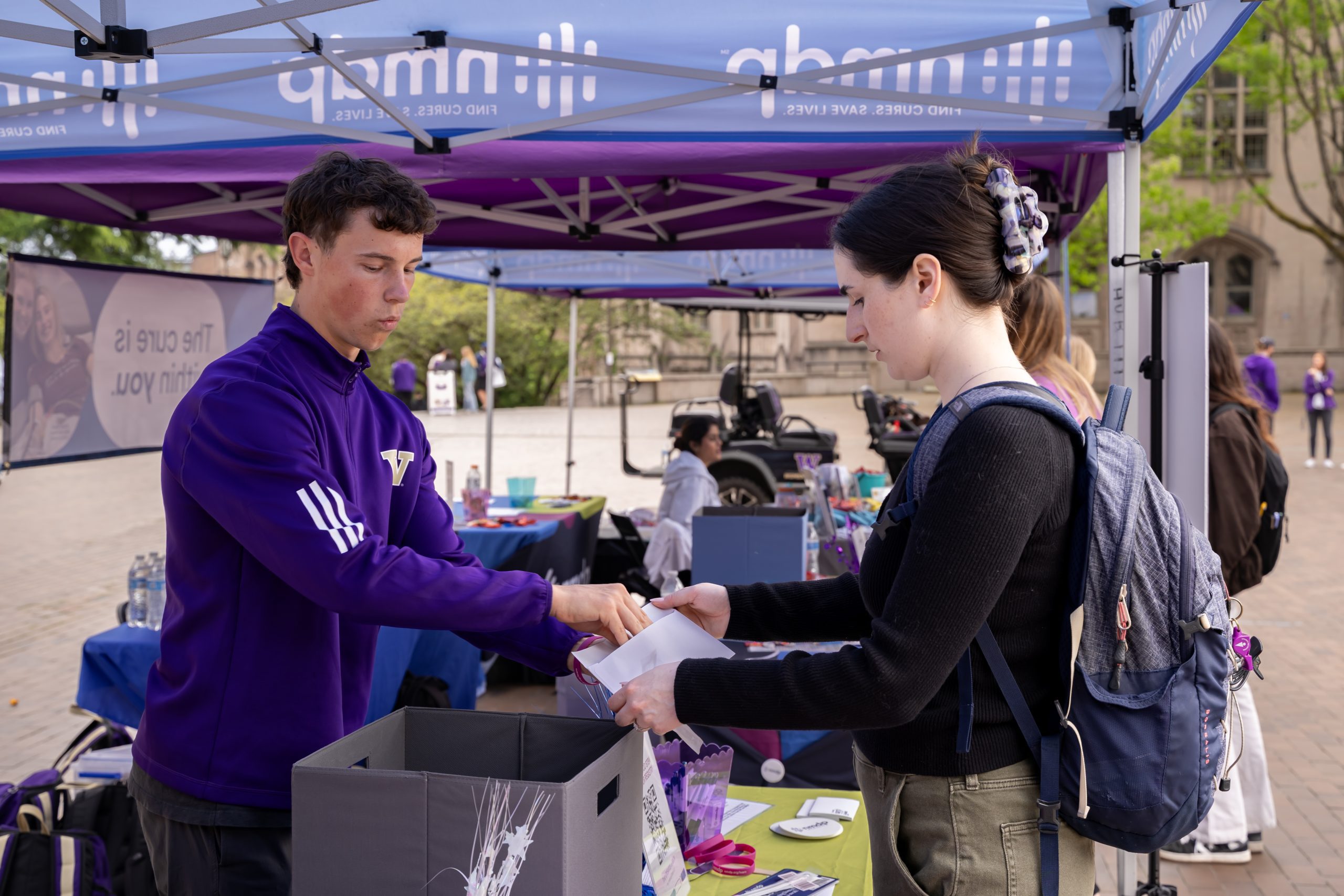
For the past six years, The Whole U has partnered with NMDP (formerly Be The Match) and UW Athletics to host Get in the Game, an annual event encouraging Huskies to join the registry of potential bone marrow and blood stem cell donors. More than 2,000 UW students, staff and faculty have stepped forward over the years, swabbing their cheeks in Red Square and signing up with the hope of one day being called to save a life. 

Alexes Harris and Ed Taylor attend Get in the Game.

This year, that hope became reality. UW has its first confirmed match: sophomore Alana Geylani, who is donating her blood stem cells to help a patient in need. 

A pre-sciences UW student with growing interest in the field of public health, the match couldn’t be more perfect.

Inspiration & First Steps

Alana’s journey began in a class discussion during her freshman year. In her sociology course, Professor Alexes Harris shared her own story of how a bone marrow donation saved her life and gave her the chance to watch her daughter graduate. 

“I tell my students every year that signing up for the registry is one of the simplest, yet most powerful, acts you can do for another person,” said Harris.

“To see Alana take that message to heart and now step forward as UW’s first match—it’s truly inspiring.” 

In that same classroom, Harris also asked students to think critically about health disparities in cancer treatment, especially for people of color. She posed the question: Why are so many underrepresented populations missing from the registry, and what does that mean for patients seeking a match?

Hear more from Alexes Harris in a local King 5 segment:

Getting the Call

For Alana, who was already thinking about her own mother thousands of miles away, the discussion struck a personal chord. She left class determined to take action, and not long after, she signed up on Red Square. 

At the end of July, Alana’s phone rang with unexpected news. She was a near-perfect match for a patient. “At first, I thought it was spam,” Alana admitted with a laugh. “But once I heard the voicemail, I called back right away. I was nervous and speechless, but the moment I learned that I could save someone’s life, I knew I had to do it.” Her decision to say yes came naturally. With a growing passion for public health, Alana saw this as an extraordinary opportunity to make a difference. 

Alana was especially moved by just how close of a match she was. “Knowing my genetic match was nearly identical made the experience feel deeply personal—almost like it was meant to be. Something in me kept saying this was exactly what I needed to do.”

Although privacy rules mean she cannot share details about her recipient’s identity, Alana emphasizes that this person, and their story, remains at the heart of her journey.

Alana during her donation appointment.

Donation Process

Since then, Alana has been busy with clinic visits, phone calls and learning the step-by-step process of donating blood stem cells. She was surprised to learn about the care and logistics involved, from volunteer couriers hand-carrying donations to the strong support system NMDP provides to donors and families.

“They’ve helped with everything—explaining each detail, supporting me emotionally, even helping my cousin travel to be by my side,” Alana shared.

Personal Reflection

For Alana, this experience has only deepened her interest in public health and her appreciation for the power of human connection. 

“Knowing that a part of me could make such a big difference in someone’s life fills me with gratitude and pride,” she said. “Something in my mind just told me this was what I was meant to do.” 

A Message to Others

Alana hopes her story will inspire others at UW to join the registry. 

“Whoever’s out there debating on whether or not to sign up—just think about how impactful this small decision can be,” she said. “It’s a chance to give hope and maybe even a second chance at life.” 

A Wellness Perspective

 “This moment is such a powerful reminder that wellness is not just about physical health, but about connection, purpose, and giving of ourselves,” said Lauren Updyke, Executive Director of Employee Experience and UWHR Chief of Wellness.

“Alana’s generosity shows us that each of us has the ability to make a life-changing impact, and it inspires our whole UW community to consider how we can show up for one another.” 

UW Athletics and Community Support

From the beginning of this partnership, UW Athletics has played a central role in championing the cause. The mission has been especially inspiring to the UW Women’s Soccer team, who shows up in large numbers each year to the Get in the Game event. 

“Alana’s courage and selflessness reflect the very best of our Husky family,” said Head Women’s Soccer Coach Nicole Van Dyke.

“For all of us in UW Athletics, being part of this journey with NMDP and The Whole U fills us with such joy and gratitude. Moments like this remind us what service and community truly mean. We are forever thankful to Alana and to Dr. Harris, whose powerful story continues to inspire our community, and we hope Alana’s example encourages more Huskies to join the registry for a chance to save a life.” 

Nicole Van Dyke and the UW Soccer coaching team at the Get in the Game event.

As UW celebrates its first confirmed match through Get in the Game, the impact of this partnership is clear: every swab is a chance to save a life. And now, thanks to Alana, one patient’s story continues. 

You Can Join Too

Our UW NMDP student organization will be co-hosting an event in Red Square on October 22 and 23 from 10 a.m. to 3 p.m. each day. Stop by the event and follow along with UW NMDP on Instagram. 
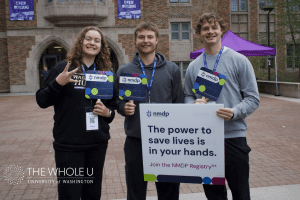
UW student athletes and volunteers spread the word.

Get Involved Today

To register, visit join.nmdp.org/UW
or Text UWSAVES to 61474

Special thanks to TIAA for Sponsoring The Whole U and Get in the Game.

Staying safe for fall and winter hiking

As an avid hiker and backpacker, I have experienced the PNW in all its weather elements. I am the Chair of the Mountaineers Foothills Branch Backpacking Committee, Co-Creator and Administrator for a beginning hiking series called GoHike, and an urban walk leader. My emphasis on safety is a priority. I help participants gain confidence, practice leave no trace principles and foster a space for belonging. I welcome all levels of physical abilities and create a community of outdoor enthusiasts who take care of one another on the trails.

The wintry weather is here, and safety essentials are necessary on our trails. We need options for the wet, cold, and snowy trails to recreate on. Snow fans rejoice this time of year because snowshoeing, skiing and snowboarding opportunities abound. But what about the rest of us who just want to get on the trails and hike? While it can be exciting to hike in snow, see animal tracks, and be in awe of frozen waterfalls, lakes and experience the moody, misty wonders of our PNW trails, additional safety measures are essential.

Fortunately, with a little knowledge, prep, and awareness, hiking safely in the colder months is possible.

What can I do to prepare?

Be aware of the conditions of the roads and trails before you go.

Bring a map – dI cannot emphasize how important a map is and knowing how to use it! Check out the smartphone apps Gaia or All Trails to download maps to use offline while hiking. Both have affordable subscription rates. Paper maps are also available at local outdoor retailers. Remember, phones can die, so bring your battery pack and a paper map as a backup.

Know before you go! Check out Washington Trails Association for current trip reports, weather forecasts, current conditions, and parking passes required at trailheads.

Captured by Christina Buckman

What are the essentials for hiking during the fall/winter?

1. Always bring the 10 essentials, regardless of the season!

  • Headlamp/sun protection/first aid/knife/fire starter/shelter (emergency bivy)/extra food, water, and clothes.
  • Consider hiking poles: They help with joint impact and balance.

2. Reduced visibility is often the case in the colder hiking season. Know the forecast, and prepare for it to change.

3. Best practice is to not go alone, but if you do, tell someone where you will be, and when you expect to be back. Providing GPS coordinates of the trailhead you start at is an immense help should you need someone to help in an emergency. GPS coordinates can be obtained on Google Maps by clicking on the location of the trailhead. Copy and paste in the message you send to your emergency contact.

4.Be aware of hypothermia and the signs that could mean trouble.
Never wear cotton. A hiking cardinal rule! If it gets wet in our climate, it will not dry and can cause hypothermia to set in fast. Wear wool or synthetic layers and have extras just in case.

5. Proper footwear.
Unless you are snowshoeing, on skis or boards, hiking on trails may sometimes require strap-on micro-spikes or Yaktrax. They are inexpensive and will give you the added confidence on trails that may be icy or snowy. Make sure to have hiking boots that have good traction and are waterproof, to keep your feet from getting wet. Dry feet are happy feet!

Captured by Christina Buckman

What are other resources for information on hiking and other outdoor adventures?

My go-to is Washington Trails Association– Not only does it have the most comprehensive trail database with search components to cater to your needs, but timely articles, current trip reports and opportunities to give back. We owe a great deal of thanks to those diligent WTA volunteers who spend time on the trail keeping it safe for us.

The Mountaineers – With a myriad of courses, clinics and seminars spanning a variety of activities, the options are endless, and you know you will be well cared for with expert leaders. Scholarships available for memberships and courses.

REI Expert Advice

REI Uncommon Path: Blog

Where can I get inspired?

Instagram can be a great resource for inspiration, without having to read long articles or blog posts. Check out the IG handles I follow below for diversity, inclusivity, body positive profiles, helpful tips, and travel pics for inspiration.

  • Her PNW Life – community of adventurous women in the PNW
  • Issaquah Alps Trails Club – Dedicated to engaging the public to preserve, protect & promote the land, wildlife, and trails.
  • The Mountaineers – Nonprofit, volunteer-led org working to inspire a lifetime of outdoor adventures.
  • Brown Girl Outdoor World – Black, Indigenous and Anti-racist POC 2SLGBTQ+ in the outdoors
  • She Colors Nature
  • Unlikely Hikers – Body liberation and anti-racism outdoors
  • Women Who Hike – Empowering women who hike on and off the trail.

Captured by Christina Buckman

How can I build community?

Having a sense of belonging and community as outdoor enthusiasts is essential, and incredibly rewarding. I highly encourage you to research options where you can meet new people, to learn from and be inspired by one another. My volunteer work with the Mountaineers has been and continues to be, the greatest source of my inspiration. The best part is making lifelong friendships and connections. We are fortunate to live in a state surrounded by water and mountains. Get out there, be safe, have fun, and hike on!


Christina Buckman (she/her) is a UW Alumni and works as an Academic HR Business Partner on the Bothell Campus. As an employee of the University for 11 years, she is proud to be a Husky. As an avid hiker and backpacker, she is a mentor and leader with the Mountaineers, where she focuses on safety, inclusivity, body positive mentorship and makes sure everyone feels a sense of belonging as she shares her passion for the outdoors.


Unlocking personalities: Understanding yourself and others

Have you ever wondered why people think, feel, and behave so differently from one another? 

 In an enlightening webinar titled “Unlocking Personalities,” Dr. Michael Johnson, the Boeing Company Endowed Professor of Business Management, explored how understanding the Big Five personality model can help us better comprehend our own and others’ behavioral patterns.   

The Big Five Personality Dimensions

From Dr. Michael Johnson’s ” Unlocking Personalities: Understanding the Big Five Model” webinar presentation, University of Washington, 2024

Openness to Experience

  • Core Traits: Creative, curious, and receptive to change 
  • Workplace Impact: Excel in roles requiring innovation and creativity 
  • Career Implications: Strong tendency toward artistic and scientific fields 
  • Professional Development: Best suited for roles involving innovation and strategic thinking

Conscientiousness

  • Core Traits: Organized, reliable, and achievement-oriented 
  • Workplace Impact: Strongest predictor of overall job performance 
  • Career Implications: Lower rates of workplace deviance, higher task completion 
  • Professional Development: Excels in roles requiring attention to detail and reliability

Extraversion

  • Core Traits: Sociable, assertive, and energetic 
  • Workplace Impact: Enhanced performance in sales and management roles 
  • Career Implications: Natural tendency toward leadership positions 
  • Professional Development: Thrives in roles requiring interpersonal engagement

Agreeableness

  • Core Traits: Warm, cooperative, and sympathetic 
  • Workplace Impact: Higher levels of organizational citizenship behavior 
  • Career Implications: Strong team collaboration and support capabilities 
  • Professional Development: Best suited for roles requiring interpersonal harmony

Neuroticism (Emotional Stability)

  • Core Traits: Tendency toward emotional variability and stress sensitivity 
  • Workplace Impact: Influences stress management and pressure handling 
  • Career Implications: Affects decision-making under pressure 
  • Professional Development: Benefits from roles with structured support systems 

Using the Big Five Model for Personal and Professional Development

Understanding your Big Five personality profile offers more than just self-insight – it provides a framework for personal growth, professional development, and building better relationships with others.  

Personal Growth 

Self-awareness: Recognizing one’s standing on the Big Five dimensions can lead to greater self-awareness. For example, if you know you are low in conscientiousness, you can focus on developing strategies to improve organization and reliability. Similarly, if you score high in neuroticism, you can work on stress management and emotional regulation techniques. 

Managing Strengths and Weaknesses: Each trait has potential strengths and weaknesses. High scores in a particular trait might lead to beneficial outcomes in certain situations and less so in others. For example, while high extraversion can benefit networking, it might also lead to overstimulation and the need for solitude for some people. Knowing these potential downsides enables you to manage and adapt your behavior effectively. 

Targeted Development: By understanding your personality profile, you can target specific areas for personal development. For example, those low in openness can consciously work on being more receptive to new experiences and ideas. Individuals can consciously work on their behavior and personality, such as becoming warmer or more assertive. 

Interpersonal Relationships  

Understanding Others: Awareness of the Big Five model can help you understand how others think and act. For example, if you interact with someone low in agreeableness, knowing they may “tell it like it is” can help you avoid taking their directness as a personal attack.  

Team Composition: Knowledge of personality traits is helpful in team composition and role assignment. Understanding that agreeable individuals are more likely to engage in organizational citizenship behaviors can help build teams. Placing an individual high in openness in a role that requires innovation can foster creativity.  

Effective Communication: The Big Five can affect communication styles. For instance, extroverts tend to be talkative and assertive, while introverts might prefer to communicate in writing or one-on-one settings. Recognizing these differences can lead to more effective interpersonal communication. 

Leadership: Extraversion strongly correlates with leadership emergence, and those high in this trait tend to be assertive and energetic. On the other hand, high neuroticism can negatively affect leadership effectiveness. Understanding these connections can help you recognize and develop your leadership skills and styles.  

Relationship Dynamics: Agreeableness is linked to increased organizational citizenship behaviors, and agreeable people are warm, cooperative, and sympathetic. However, very high agreeableness can sometimes be seen as naive. Effective interpersonal relations require a balance of agreeableness and assertiveness. Interpersonal traits such as extraversion and agreeableness are linked to cooperation, sensitivity, warmth, and social coordination behaviors. 

UW Resources for Personal Growth and Professional Development

Understanding personality traits is valuable, but putting this knowledge into practice often requires support and guidance. The University of Washington offers two key resources to help you on this journey. The Washington State Employee Assistance Program (WA EAP) provides PEBB-eligible employees and their household members with confidential support, including solution-focused counseling services. You can access up to 3 sessions per concern and use this benefit multiple times throughout the year as different challenges arise. 

For additional support in specific areas of life, UW WorkLife offers valuable resources for managing both personal and professional challenges. Whether you’re seeking guidance on workplace relationships, looking for work-life balance strategies, or needing support for caregiving responsibilities, these programs provide the practical tools and information you need to thrive both at work and in your personal life. All services are confidential and designed to support your overall well-being. 

If you missed the live webinar or would like to review the content, a recording is available on The Whole U’s YouTube:

Looking Forward

Dr. Johnson recommended completing a free Big Five assessment at bigfive-test.com for those interested in learning more about their personality profile. He also suggested further reading, including “Me, Myself, and Us: The Science of Personality and the Art of Well-Being.” by B.R. Little and “Quiet: The Power of Introverts in a World that Can’t Stop Talking.” by Susan Cain. 

Spend wisely for the holidays with tips from BECU

The holiday season is a time for joy, connection, and generosity, but it doesn’t have to be a time for financial stress. Our partners at BECU have shared some practical tips to help you navigate holiday spending while staying on budget.

From creating a detailed holiday budget to finding creative gift ideas, these insights can help you make the most of your resources while spreading holiday cheer. Below are BECU’s top tips for budget-friendly holiday spending:

1. Assess Your Savings

Take a close look at your essential expenses and determine how much you can allocate for holiday spending.

2. Review Your Debt and Credit

Before using credit cards, evaluate your current debt and consider how much you can reasonably afford to repay. Set spending limits—and stick to them.

3. Make a Gift List

List everyone you’re planning to shop for and estimate your spending for each person. Compare the total with your budget and adjust as needed.

4. Give Experiences Instead of Physical Gifts

Create lasting memories with experience-based gifts, like a snowshoeing trip or a paint-and-sip class. You can also explore DIY gift options, but remember to factor in the cost of materials.

Gift cards can be a budget-friendly option, keeping costs predictable. This year, BECU is offering discounted pre-paid cards in partnership with Black Friday promotions.

5. Consider Gift Cards

Another great way to combat inflation is with gift cards. They can keep the cost of gifts down by staying true to the budget, and you won’t have to worry about taxes or shopping around for the best price; it’s a win-win on both sides.

6. Plan for Travel Costs

If you’re traveling, account for expenses like transportation, accommodations, and activities. Plan ahead to avoid surprises.

7. Budget for Last-Minute Gifts

Set aside funds for unexpected expenses, like an unplanned holiday party or last-minute guest. If unused, roll this amount into next year’s holiday budget.

8. Search for the Best Prices

Use tools like CouponCabin, RetailMeNot, and SlickDeals to find deals and promo codes. Compare prices to ensure you’re getting the best value.

9. Factor in Costs for DIY Gifts

While homemade gifts can save money, they come with material costs and take time. Budget for these expenses.

10. Include Charitable Giving

If you plan to donate this season, include charitable contributions in your holiday budget. Consider incorporating donations into your year-round financial plan.

11. Watch Out for Scams

Stay vigilant against phishing scams and copycat websites that could compromise your personal information.

Plan for Next Year

Once the holidays are over, start preparing for next year. Open a separate savings account or envelope, and contribute to it monthly to build your holiday budget gradually.

These tips are shared by BECU and are intended for general financial education. For personalized advice, consult a qualified financial professional.

How to find new hobbies and foster creativity

In the ever-lasting quest for a balanced life, making space for hobbies, passions and creativity can be a pivotal key in finding our equilibrium. Our hobbies are an important way to express our creativity and to explore who we are. They can also bring challenges, a sense of accomplishment, and an opportunity to connect with others. In fact, creativity is central to human activity and thought. It has been the driving force for all innovation throughout human history.

But with the energetic drain of our daily responsibilities, it is easy to neglect space for creativity and hobbies. We need this space in order to thrive. If we are looking to change our lives and find joy in the moments between the monotonous day-to-day responsibilities, putting effort into a new hobby might be just the thing for you. As the saying goes, “You are never too old and it is never too late.”

Start by following your feelings

It can be hard to find a new hobby if you have not already invested years into one, especially as an adult. Where can one start? One of the first steps into exploring new hobbies and passions is to follow your feelings! Listen to yourself, your reactions to activities you are already doing, and bring awareness to your feelings during your experiences. Try asking yourself these questions as you explore:

  • Where do you find joy?
  • Where do you find peace?
  • What do you value?
  • What are you interested in?
  • What are some activities that you currently do that allow you to seem to lose track of time?
  • Take some time to reflect (maybe even start a journal) and ask yourself these questions. As you take the time to answer these questions, take this as an opportunity to explore and get to know yourself better!

Revisit your inner-child

It’s been said that the child-versions of ourselves are the most authentic version of ourselves. As you dive deeper into your self-exploration, ask yourself what you enjoyed as a child. Revisit these experiences and see how you feel. Were you always playing outside? Try exploring a hobby that will take you out in nature. Did you enjoy being active and playing sports? Try joining a team sport. Were books in quiet corners more of your thing? You might find joy in a book club or with a writing group. As you take this journey to your hobbies, you may find a path leading you to your most authentic self.

Create a space for creativity

Once you’ve found a hobby you are interested in, create space. Literally and figuratively. Set a dedicated time in your week to immerse yourself completely in this your hobby. Most of us have been taught that when it comes to time, productivity is what matters most. As a result, we’ve structured our lives around work rather than play. But with a little thought, you should be able to find more time in your schedule to do the things you love.

If you are taking up a new hobby that can be done from your home, set up a dedicated space. A workshop, music room, art space, etc… You’ll find that having this space already set up and committed to your craft will help you stay consistent in your practice. Think of this like a meditation. You won’t be able to experience the full joy and wonder of your craft unless you stay committed to the practice.

Patience and Process, Not Productivity

Your hobby is not about producing or presenting something for others. This is your craft. Your practice.  Allow yourself to get lost in the highs and lows of immersing yourself in a practice, without the attachment to leave something behind. Try to put aside the strange pressure we feel to “prove” ourselves and simply do to do. Create to create, then, watch yourself grow along the process.

Looking for somewhere to start?

See if the following free, creative classes with The Whole U interest you. You may strike a new passion! Follow along on YouTube.

History of Japanese Origami Workshop with Guided Creation

Origami is the art of paper folding and a traditional Japanese culture. This workshop will introduce the background of the origami culture and also give guided instruction in creating origami. In the first half, the presenters will talk about several topics: the history of origami, its symbolism of peace, applications in science and industry, and other benefits. In the second half, the presenters will show some examples and give guided instructions for those wishing to try it themselves.

Art Series with Miha Sarani 

Do you have an appreciation for the arts? This virtual workshop series with Mihai Sarani explores:

Learn more about various forms of art and have fun trying something new with UW alum Miha Sarani, visual artist, art historian, and art educator. These workshops are appropriate for all ages.

Intuitive Painting Workshop with Studio Life 

Join Studio Life and instructor Lotte Goede for a time of spontaneous painting by tapping into our creative intuition. No experience necessary! You will quiet the minds, connect within and paint from intuition. This workshop is about creative exploration and freedom – a process of letting go and joyful discovery in a non-judgmental space.

There are no mistakes here. You’ll be transforming your canvas with every layer, which in turn will inspire your next step.

Watercolor Painting Class with Sarah Simon of TheMintGardener 

Join Studio Life and watercolor expert Sarah Simon of The Mint Gardener for a watercolor painting workshop. During this 90-minute workshop, Sarah will share how she has been able to expand her creativity through watercolor painting and starting her business The Mint Gardener. Sarah will then instruct a leaves and florals watercolor painting workshop.

All levels are welcome!


Wherever you are in your creative journey, The Whole U is here to help you stay on track with your goals and connect you to exciting, new opportunities. Share with us what forms of creativity you love or have found in the last year in the comments below!

Smartphone photography 101: A guide to stunning shots

“The best camera is the one that’s with you.” – Chase Jarvis

In today’s fast-paced world, our smartphones are more than just communication devices. They’re powerful cameras that we carry with us every day. Whether you’re capturing moments on the go or working on your creative portfolio, your smartphone is a fantastic tool for photography. In this blog, I’ll take you through the essentials of smartphone photography, with tips that will help you elevate your skills from casual snaps to professional-quality images.

About Me
Hi, I’m Sebastian Ky, a multimedia specialist with a passion for photography and digital storytelling. I’ve spent years exploring the art of visual communication, and today, I’m excited to share my knowledge of smartphone photography with you. Let’s dive in!

Understanding your smartphone camera

The first step to great smartphone photography is to familiarize yourself with your camera’s settings. Here are the three key settings you need to master:

  • Resolution: High resolution ensures your photos are crisp and detailed. Always set your camera to the highest possible resolution for the best results.
  • HDR (High Dynamic Range): This feature enhances your images by balancing the light and dark areas. Use it in scenes with high contrast, like a sunset or a backlit subject.
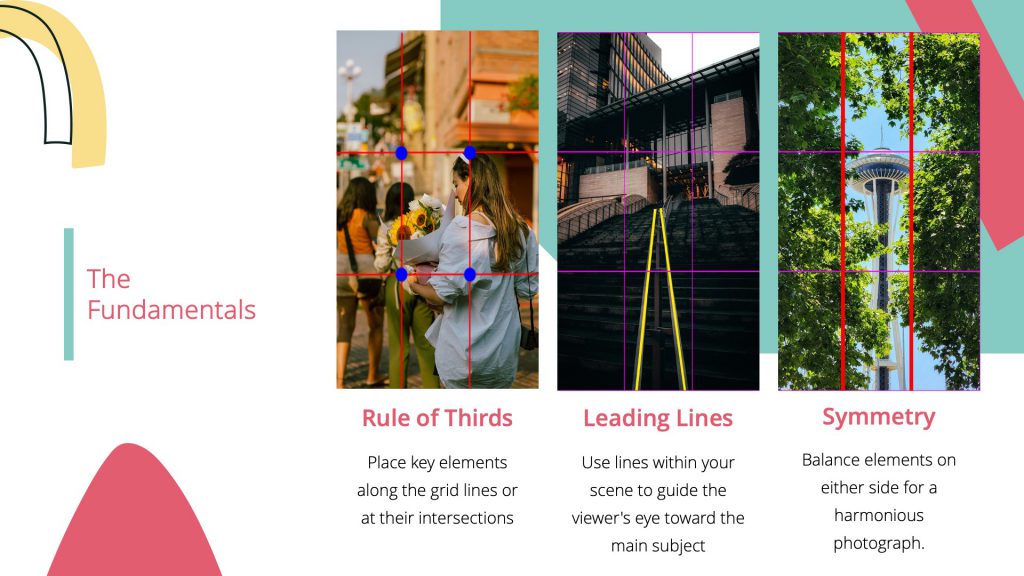
  • Gridlines: Enable gridlines to help compose your shot using the Rule of Thirds, a powerful composition tool that we’ll explore next.

Example: Imagine you’re on vacation, capturing a beautiful landscape. Turn on HDR to ensure the sky doesn’t get washed out, and use gridlines to position the horizon perfectly, enhancing the balance and aesthetic appeal of your shot.

Composition techniques: the art of framing your shot

“A good photograph is knowing where to stand.” – Ansel Adams

Composition is the backbone of any great photo. It’s about how you arrange elements in your frame to create balance and focus. Here are some essential techniques to try:

  • Rule of Thirds: Imagine your screen is divided into nine equal sections. Place your subject along these lines or their intersections for a balanced, dynamic shot.
  • Leading Lines: Use natural lines in your environment, like roads, rivers, or architectural features, to guide the viewer’s eye toward your subject.
  • Symmetry and Balance: Symmetry can create striking images, while balancing elements on either side of your frame ensures harmony.

Example: While photographing a street scene, use leading lines from a pathway or a row of buildings to naturally draw attention to your main subject, whether it’s a person or a distant landmark.

Lighting fundamentals: mastering light for stunning photos

“Where light and shadow fall on your subject—that is the essence of expression and art.” – Scott Bourne

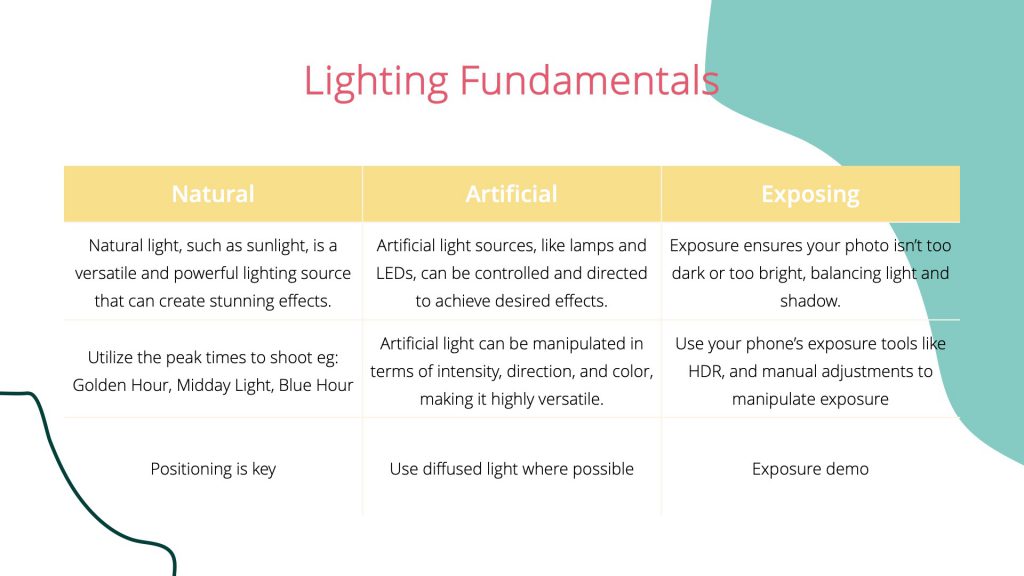
Lighting can make or break a photo. Natural light is often the most flattering, but learning to work with artificial light is also important. Here’s how to handle both:

  • Natural Light: Use the golden hour (the hour after sunrise or before sunset) for soft, warm light. The midday sun can be harsh, so look for shade or shoot with the sun behind your subject.
  • Artificial Light: Experiment with light sources like lamps or LED lights. Play with angles and intensity to create the mood you want.
  • Exposure: Adjust your camera’s exposure settings to control how light or dark your photo is. Many phones allow you to tap on the screen to manually adjust the exposure for different parts of the scene.

Example: For a portrait shot outdoors, position your subject so the light falls softly on their face, avoiding direct overhead sunlight. Indoors, use a soft lamp to add warmth and eliminate harsh shadows.

Focus and depth of field: highlighting your subject

“To me, photography is an art of observation. It’s about finding something interesting in an ordinary place.” – Elliott Erwitt

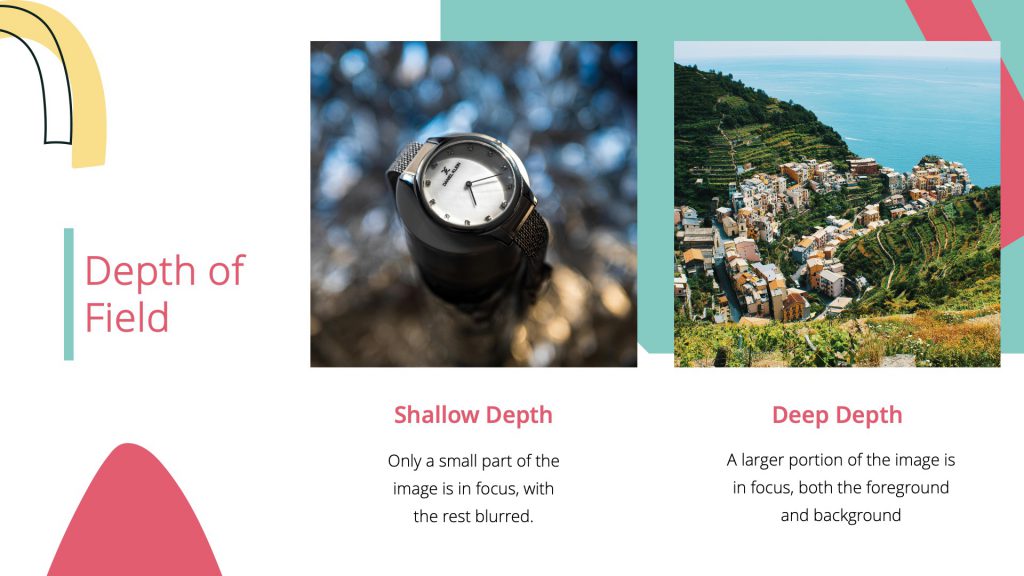
Focus and depth of field allow you to control which parts of your image are sharp and which are blurred, helping you highlight your subject:

  • Auto-Focus: Let your smartphone automatically detect the subject and adjust focus accordingly.
  • Tap to Focus: In complex scenes, tap on your subject to ensure the camera focuses on the right part of the image.
  • Portrait Mode: This mode creates a shallow depth of field effect, blurring the background and keeping your subject in sharp focus—perfect for portraits or food photography.

Example: When taking a portrait, use Portrait Mode to keep the person’s face sharp while softly blurring the background for a professional, polished look.

Editing essentials: enhancing your photos post-shoot

“You don’t take a photograph, you make it.” – Ansel Adams

Once you’ve taken your shot, editing can elevate it even further. Here are some basic adjustments to improve your photos:

  1. Adjust Exposure, Contrast, and Color Balance: Small tweaks can make your photo brighter, more vibrant, or more dramatic.
  2. Crop and Straighten: Remove distractions and ensure your photo’s horizon is level for a cleaner composition.
  3. Filters and Presets: Play around with filters to change the overall look and feel of your photo. Apps like VSCO or Lightroom offer a variety of presets that can give your images a unique style.
  4. Exporting: Export your photos in the correct format for their intended use—JPEG for everyday use, PNG for high-quality images on the web.

Example: After capturing a street market scene, brighten the exposure slightly, adjust the color to make the produce pop, and crop out unnecessary elements to draw attention to the vibrant market stalls.

Practical tips and tools: taking your photography further

To conclude, here are some practical tips for honing your smartphone photography skills:

  • Clean Your Lens: This simple step can drastically improve image quality.
  • Steady Your Shot: Use both hands or a tripod to reduce blurriness from hand movement.
  • Experiment: Don’t be afraid to try new angles, lighting setups, and editing styles. Photography is about creativity and discovery.

Download the Smartphone Photography 101 slides!

With these tips in hand, you’re well on your way to capturing stunning images with your smartphone. Whether you’re photographing family gatherings, breathtaking landscapes, or everyday moments, remember that great photography is all about seeing the world in new ways. Happy shooting!

Distinguishing fact from fiction in the media

Many sources compete for attention online and in our social media feeds, including partisan blogs and bogus sites posting as legitimate news organizations. It can be tough to know what to trust. Follow these five steps from the News Literacy Project to cut through the noise and learn how to evaluate sources for signs of credibility — as well as red flags that signal a source should be avoided.

5 step assessment

1. Do a quick search

Conducting a simple search for information about a news source is a key first step in evaluating its credibility. It’s important to look beyond social media. Go to a search engine and plug in the name of the website or publication. Do other legitimate resources, such as standards-based news organizations or fact-checking websites describe this publication as unreliable? Satirical? Is it a state-run propaganda “news” site? If so, there’s no need to spend more time vetting. Look elsewhere for reliable information.

Tip: Wikipedia can be a good place to start and lead you to relevant source links. Just keep in mind that some credible local newsrooms may not have an entry there. You can also see if a source has been vetted for inclusion on news aggregators, such as Google News, Apple News and SmartNews.

2. Look for standards

Reputable news organizations aspire to ethical guidelines and standards, including fairness, accuracy and independence. These standards should be available publicly — often in the form of editorial policies or a code of ethics. Look for evidence that a source follows such standards. If someone is mentioned in a critical story, for instance, did the journalist give that person a chance to comment?

Note: Some professional journalism standards are commonly shared across the industry, such as the Society of Professional Journalists Code of Ethics. Other policies are unique to different newsrooms.

3. Check for transparency

Quality news sources should be transparent, not only about their reporting practices (see step 2), but also about their ownership and funding. Is it clear who owns and runs this website or publication? Is advertising labeled responsibly? Can you tell who is writing and producing content? Is there a way to contact newsroom editors and reporters?

Remember: “About” pages can provide some of these details, but they can also be misleading and omit important information (about a source’s ownership or lack of independence, for example). Don’t be fooled by a sleek web design or trust the “About” page on an unfamiliar site without further verification. If something seems suspicious, check it out.

4. Examine how errors are handled

Credible news sources are accountable for mistakes and correct them. Do you see evidence that this source corrects or clarifies errors?

5. Assess news coverage

An important step in vetting sources is taking time to read and assess several news articles. Do you see original reporting? Do they provide straight news reports or just commentary and opinion? Are there grammatical and/or spelling errors? How do news articles from this source compare to coverage from other standards-based newsrooms on this same topic? Many people have strong opinions about news sources without evaluating them firsthand.

Tip: Take note of the bylines (names) on news coverage. These bylines can help you confirm that this coverage was written or produced by professional journalists. Bylines are also a sign of transparency and accountability.

Beware of these trust busters

If you spot any of these problems, look elsewhere for credible news.

  • False or untrue content – Publishing a demonstrably false claim without correcting it.
  • Clickbait tactics – “Baiting” you with sensationalized language, including misleading or exaggerated headlines or headlines that are purposely vague to drive clicks.
  • Lack of balance – Consistently focusing on one angle or side of a legitimate debate or controversy, while ignoring or distorting other perspectives.
  • Manipulated images or videos – Misrepresenting or altering visuals or generating them using AI. You can do a reverse image search using Google, TinEye or Yandex (among other tools).
  • State-run or state-sponsored propaganda – Using government-controlled news organizations to further national agendas and improve public image.
  • Dangerous, offensive and malicious content – Could include discriminatory language, unverified pseudoscience, content that promotes violence or coverage that, as the SPJ Code of Ethics states, “panders to lurid curiosity.”

This guide was created by the News Literacy Project in partnership with SmartNews.

UW battles misinformation and disinformation

The University of Washington has world-renowned experts and resources to combat misinformation and disinformation. Much of this knowledge is consolidated in the UW Center for an Informed Public. To learn more, check out:

Calling Bullsh*t – this celebrated book and course, created by UW Professors Carl Bergstrom and Jevin West of the UW Center for an Informed Public, offers a wealth of useful advice, tools and resources to combat misinformation and disinformation.

MisinfoDay – the Center for an Informed Public’s annual media literacy educational event brings together high school students, teachers and librarians to learn how to navigate complex information environments and make informed decisions about what to believe online. The site offers an informative resource library.

Confronting Fake News and Misinformation – the UW has aggregated resources to help students develop critical thinking skills that are the cornerstone of informed and responsible civic engagement.

Beyond the UW, here is a list of many other organizations fighting fake news.

Support

You can support the UW Center for an Informed Public. Or, please consider making a one-time gift or setting up a monthly payroll deduction through the UWCFD to support one of our member organizations working to fight misinformation and dedicated to fair, truthful and accurate news reporting:

Internews Network – trains journalists, tackles disinformation and helps media outlets become financially sustainable so that everyone has trustworthy information to make informed decisions and hold power to account (Charity Code: 1479810).

States Newsroom – The nation’s largest state-focused nonprofit news organization, with reporting from every capital (Charity Code: 2006548).

National Public Radio – an independent, nonprofit media organization that cultivates an informed public, fostering a deeper understanding and appreciation of events, ideas, and cultures (Charity Code: 0519253).

KUOW Public Radio – an independent, nonprofit news organization that produces award-winning journalism, innovative podcasts, engaging community events, and more (Charity Code: 0315756).

Cascade PBS – a community-licensed and supported public television station and media organization with a mission of inspiring a smarter world through high-quality, accurate, local, relevant media—on air, online and in-person (Charity Code: 0315693).

Northwest Public Broadcasting – a regional radio network dedicated to enriching Northwest communities by sharing and creating distinctive programs which engage, enlighten and entertain (Charity Code: 0330094).

Password phishing scams: How to avoid them

Learn how you can protect yourself from the fake alerts and emotional plays scammers use to steal your passwords with this thorough guide from our partners at BECU.


 Takeaways: Common phishing tactics and how to avoid them

  • Password phishing is when scammers posing as legitimate organizations contact you (usually about a fake urgent problem), to steal your passwords and access to your accounts.
  • Common password phishing tactics include messages about fake password resets, fake package delivery issues, fake prizes, fake fraud alerts and fake charities during real disasters.
  • Phishing is a widespread problem and can lead to a loss of access to bank and personal accounts, fraudulent credit card charges, and fake social media posts.
  • Some ways to protect your money and identity include using a password manager, choosing a password that is at least 15 characters, employing hard-to-guess security questions and enrolling in multi-factor authentication.

What are password phishing scams and how do they work?

Password phishing involves scammers using any method of communication — often about a fake urgent problem that seems to require your immediate attention — to steal passwords to your banking, credit card, health care or entertainment accounts, or trick you into giving your passwords away.

Scammers often pose as people or organizations you’ve interacted with or that sound official, such as businesses, government organizations and trusted service providers. They might contact you through emails, phone calls, voicemails, text messages or social media with an offer that sounds too good to pass up, or a threat to discontinue a service you rely on if you don’t respond right away.

The scammers’ message often contains a link. This link prompts you to enter your username, password or authentication code, or it will launch malicious software giving scammers access to your login information.

Scammers then use this information in a few ways:

  • Stealing money from your bank or credit union account.
  • Stealing your personal or corporate files and photos.
  • Making fake social media posts to scam others.
  • Impersonating you by email or in other ways to target your family and friends for scams.

If scammers contact you by phone, they often try to convince you to give them account information, authentication codes or credit card details. If your credit card is involved, the scammer might run up charges on your card.


Common password phishing scams and tips to protect yourself

Here are a few common methods scammers use to steal your personal information and some tips to help you protect yourself.

Fake password resets

Fake password reset messages are when a scammer calls you or sends a phishing email or text telling you that you must reset your password or provide information to verify your account. The messages often pretend to come from big brands such as Microsoft, or social media platforms like Facebook.

These types of attacks aren’t new, but they continue to be common because they are so successful.

In one scam, business executives were targeted with phishing emails that appeared to be from Office 365. The emails said the account passwords were set to expire. Users unknowingly entered their login credentials, which hackers could sell and use to send out more phishing emails.

How to protect yourself:

  • Never give passwords or authentication codes to callers.
  • Only reset your password if you initiated the reset. Companies typically won’t email you links to reset your password without you requesting it.
  • When in doubt about a password reset, go directly to the website, not through the email or text link, and reset your password there.
  • Look carefully at the email address of the sender. Make sure it’s spelled correctly. Hover your mouse over the email to make sure the address that pops up is the same as the address you see in the sender field.

Fake package tracking alerts (text or email)

In this type of phishing or smishing (SMS phishing) scam, attackers send email or text alerts claiming to have tracking information about a package, or that a package is waiting to be delivered.

The scammers say they will provide the package information after you enter personal information or make a payment. Usually, the message tries to lure you into disclosing your username and password, or credit card number.

In other cases, the scammers will try to convince you to click on a link that installs malware.

The U.S. Postal Service Office of Inspector General alerted postal service customers in which scammers sent phishing messages claiming to have postal tracking information about packages. FedEx and UPS have also cautioned their customers about these scams.

How to protect yourself:

  • Watch out for this type of scam as the holiday shopping and shipping season approaches.
  • Verify links in text and email messages match the web address of the package carrier service.
  • If you’re not sure about a messenger or sender, don’t click any link sent to you. Instead, open a new browser window, log in directly to the website and enter your tracking number there.

Fake rebates and prizes

Prizes, refunds and rebates can be hard to resist. In one type of phishing attack, scammers send phony text messages. These messages offer to send you money if you click a link where you’ll be prompted to log in or enter your banking information.

These messages might tell you the offer is for a limited time only, creating a sense of urgency.

A few fake prize scams have pretended to be from Hulu, Verizon and AT&T.

How to protect yourself:

  • Assume that if a prize is too good to be true, it probably is.
  • Pause for a moment, especially if you have to “act now” to get money deposited into your account. Most reputable companies give plenty of time to communicate a special offer or discount, and they won’t ask you to log in and provide your account number.
  • Look closely at links before you click on them. Make sure there are no spelling errors, and the links match the company website.
  • When in doubt, go straight to the website and see if the special offer or contest is advertised there.

Fraud alert phishing attacks

In a fraud alert phishing scam, scammers impersonate financial institutions or credit card companies with text alerts about fake fraud attempts. These types of scams play on the fear of exactly what the scammers are trying to do: Gain illegal access to your accounts and drain your funds.

Scammers have targeted BECU members with this type of phishing scam.

How to protect yourself:

  • Never provide your online banking user ID or password. A legitimate credit union or bank won’t ask for this information via text, email or by phone.
  • Don’t click links in text messages to respond to a fraud alert. Financial institutions won’t ask you to log in from a text.
  • Contact your financial institution about any fraud alerts or threats to your account using a legitimate phone number that you look up on their official website or on your debit or credit card, or contact them through your online account.

Disaster phishing attacks

Scammers prey on vulnerable people during widely publicized hard times, posing as government agencies and fake charities during natural disasters and other crises.

Following catastrophic flooding in Texas, scammers posed as government employees and charities to steal money and personal information. Others have demanded money in exchange for information about missing loved ones.

Don’t take the bait. These are attempts to gain access to your personal information.

How to protect yourself:

  • Check websites such as Charity Watch and GuideStar to verify any charitable organizations.
  • Beware of messages that prompt you to apply for insurance or tax benefits. For stimulus payments and tax credits, the first step, if you’re eligible, is to file your taxes. Don’t respond to email or text messages soliciting donations.

Unsecured public Wi-Fi

Heading to the local coffee shop to get a little work done on your laptop seems convenient, but if you’re using an unsecured WiFi network, you’re leaving yourself vulnerable.

Scammers can intercept data as it moves between your computer and the wireless network, which is called a “man-in-the-middle” attack. If they manage to intercept your user name or password over an unencrypted channel, they might use that information to target you with phishing attempts, use your account to send phishing messages to others, or gain access to your accounts directly.

How to protect yourself:

  • Never enter banking passwords or sensitive information over unencrypted public Wi-Fi.
  • Disconnect your Bluetooth if you’re not using it.
  • Don’t shop online on an unsecured network. Attackers can potentially intercept your login credentials for the site you’re shopping on and access your payment information.
  • Use a VPN (virtual private network) to create a secure connection through an unsecured, public Wi-Fi.

4 Tips to protect against password scams

Although attackers are finding new and creative ways to steal your personal data, there are a few steps you can take to improve your overall security online.

1. Use a password manager

Using a password manager that generates random passwords can simplify the task and likely do a better job of keeping your accounts safe than you can on your own.

PCMag has reviews of password managers in several categories.

If you decide to manage your passwords without a service, be sure to create strong passwords and change them frequently. Never use the same password on multiple accounts; if it’s compromised in one account, all of your accounts become vulnerable.

2. Choose a longer password

The safest passwords are at least 15 characters long, according to the latest guidance by the National Institute of Standards and Technology.

The more characters you have, the harder it is to guess. In fact, it would take a modern laptop more than 500 years to work through all the possible combinations of a 15-character password, according to NIST.

If you’re concerned about remembering a long password, consider using a passphrase — combining several real words together.

You can include numbers and special characters to make the password harder to guess, a long password is a higher priority than a complex one, according to the latest NIST recommendations.

Only respond to password change messages if you initiated them. Remember that legitimate organizations won’t send you texts or emails, and they won’t call you to ask you for this information.

If someone calls you asking for the authentication code you just received to help you log in, don’t give it to them. It’s likely a scammer who has intercepted your data.

3. Use hard-to-guess security questions

As a secondary layer of protection, many websites require you to choose security questions and answers.

WIRED magazine calls security questions “problematic” and a “weak link” because the answers are too easy for scammers to guess.

If you are required to rely on security questions, choose questions that can’t be easily answered by a Google search.

If you’re having trouble finding a security question that doesn’t have an easy-to-discover answer, WIRED recommends against answering the security question honestly.

4. Use multi-factor authentication

Multi-factor authentication is a security feature that requires you to verify your identity at least two different ways when you login to an account. Often, you’ll enter your user name and password, then the website or app will send you a unique security code by text message, email or phone call.

This is an important added layer of security, but like all security measures, it’s still subject to hacks and scams. For example, scammers might use bots to convince you to give them your authentication code so they can access your accounts.

How To protect yourself:

  • Only enter codes for accounts you are actively trying to access.
  • Consider it a red flag if you receive a message or a call asking for your code to resolve a problem, especially if there is a sense of urgency.
  • Don’t click any links in the message.
  • Use contact information you have saved, or look it up yourself, to reach out to the organization and check your accounts.

Portrait of Katie J. Skipper

Katie J. Skipper(She, Her, Hers)
BECU Community Content Manager
Katie manages the BECU Blog and writes about personal finance topics including credit cards, budgeting, debt management, loans, taxes, home improvement, inflation, fraud and scams. She also writes about race, gender and social equity, and features the stories and expertise of BECU employees and community members.

A former journalist, she has reported for daily newspapers in Washington and Montana, including The Daily (Everett) HeraldGreat Falls (Montana) Tribune and The Bellingham Herald, covering a range of topics including government, law and justice, and the environment.


Thank you to BECU for sponsoring The Whole U!

5 reasons to visit the dentist

We all know we’re supposed to visit the dentist every six months, but it can easily drop off the to-do list. Add in a global pandemic, and not surprisingly many of us have fallen behind in our regular visits.

Making the time to see a dentist is an important way to take care of yourself. To motivate you to get back into the dentist chair, here are our top 5 reasons it really IS important to visit the dentist, courtesy of the expert faculty dentists at the UW Dentistry Faculty Dental Practice at the UW Campus Dental Center.

Keep small problems, from becoming big problems.

There’s a lot going on in your mouth that you can’t necessarily see.  A bit of decay between your teeth, tartar hiding just below your gum line, an impacted wisdom tooth.  Regular visits ensure small problems are monitored and addressed, rather than becoming larger issues later. A small, early cavity might be treated without drilling and filling, and treating gum disease now will help prevent future tooth loss. That’s something to smile about!

Oral health care is closely related to general health.

Time and time again, poor oral health is correlated with poor outcomes related to several general health conditions.  We know improving your oral health makes you a healthier person overall.  In addition, serious oral problems like cancers are detected by dentists, and early detection ensures the best prognosis and least invasive treatment.

Maintain a high quality of life.

If you’re in pain or simply uncomfortable or embarrassed with your smile, your quality of life suffers. Regular dental visits help safeguard your ability to smile, speak, and eat, by addressing issues of function or aesthetics, while ensuring healthy teeth and gums stay that way. 

Enjoy your food.

It’s difficult to enjoy the food and drinks you love when something in your mouth hurts. Instead of limiting what you eat, chewing food on one side of your mouth, or some other behavior that avoids pain, talk to your dentist!  Common issues like heat and cold sensitivity and general tooth pain can easily be addressed.  Dentists can treat these common conditions and get you back to enjoying the food you love.

Preventative care saves you money.

If your health isn’t enough of a reason to make your oral health a priority, consider the financial benefit.  Regular preventative care and other dental treatment is likely covered by your insurance and seeing your provider regularly means potential problems will be detected early.  By catching issues early, you’ll avoid more costly and invasive treatments later. More money in your pocket!

Looking for a dentist?  The UW Dentistry Faculty Dental Practice is close and on campus. Schedule an appointment with our expert dentists at 206-685-8258 or uwdentists@uw.edu.