
Skip to content

Communicating respectfully with people of all gender expressions

Gender diversity has existed throughout time and across cultures. However, in many western cultures we have been socialized to treat gender as binary, only recognizing men and women.

In this context, understanding what gender-inclusive language is and how to use it can be confusing: it’s not typically something we learn in school, it’s constantly evolving, and people’s preferences for defining their identity can vary widely and change over time.

Nonetheless, to create a more inclusive society, we should aspire toward language use that is respectful of all gender identities and reduce our use of gendered language when it isn’t necessary.

And, like any new habit, particularly one that rejects cisnormativity (the assumption that each person’s gender identity fits the binary and corresponds to the sex they were assigned at birth), incorporating inclusive language takes time and practice.

Language, whether spoken or written, is the primary filter through which most of us perceive and experience the world, and it deeply affects how we relate to and understand one another. The words that we use to describe others are often unintentionally rooted in implicit cultural biases, including biases that privilege the gender binary.

Moreover, according to the LGBTQ+ resource center at the University of Wisconsin, all of the professional associations for psychology and psychiatry in the U.S. acknowledge that inclusive language dramatically reduces experiences of depression, social anxiety, suicidal ideation, and other negative mental health factors among LGBTQ+ youth and adults.

“Being non-binary for me means existing in a world that was not built for me,” said Lauren Lichty (they/them), associate professor in the School of Interdisciplinary Arts & Sciences at UW Bothell and co-chair of the UW Faculty Council on Gender Equity and Justice.

“It means experiencing chronic misgendering, in my professional and personal life,” they continued. “Every time I enter a room, I wonder what experience I’ll have related to my identity and brace myself for misgendering. I hope someday that is no longer true. The energy it takes to decide when to correct people and when to accept misgendering- it’s exhausting and alienating.”

“However, when people get my pronouns right, or when they get it wrong and then quickly correct themselves, it’s like being washed over with warmth. I can breathe easier and feel a shift in my sense of worth and belonging.”

Understanding terms

It is easy to inadvertently confuse the terms gender with sex or sexual orientation. Gender is the cultural expression of being masculine, feminine, or any combination or absence of those concepts. Sex is the set of biological markers present at birth, including genitals, reproductive organs and chromosomes. Sexual orientation refers to which genders a person is physically, emotionally or romantically attracted to.

There are several common terms that people often use when discussing gender, as defined by the National Council of Teachers of English:

  • Gender identity: an individual’s feeling about, relationship with, and understanding of gender as it pertains to their sense of self. An individual’s gender identity may or may not be related to the sex that individual was assigned at birth.
  • Gender expression: external presentation of one’s gender identity, often through behavior, clothing, haircut, or voice, which may or may not conform to socially defined behaviors and characteristics.
  • Gender binary: a conceptual framework that defines gender as consisting solely of two categories (termed “woman” and “man”) that are biologically based (“female” and “male”) and unchangeable, and that misrepresents human biological variation and denies the existence of nonbinary variations of gender.
  • Cisgender: of or relating to a person whose gender identity corresponds with the sex they were assigned at birth.
  • Transgender: of or relating to a person whose gender identity differs from the sex they were assigned at birth. This umbrella term may refer to someone whose gender identity is woman or man, or to someone whose gender identity is nonbinary.
  • Nonbinary: of or relating to a person who does not identify, or identify solely, as either a woman or a man. More specifically:
    • Gender fluid: of or relating to individuals whose identity shifts among genders. This term overlaps with terms such as genderqueer and bigender, implying movement among gender identities and/or presentations.
    • Agender: of or relating to a person who does not identify with any gender, or who identifies as neutral or genderless.

What’s up with pronouns?

Pronouns, which are words that refer to people by replacing proper nouns like names, are getting a lot of attention these days. Some pronouns are commonly associated with a specific gender category (e.g., he for men and she for women) and some pronouns are not (e.g., they/them/theirs). You might also hear less common gender neutral pronouns such as zie/zim/zir, sie/sie/hir and per/per/pers.

Pronouns specifically refer to the person you are talking about. Each person gets to determine which pronouns are right for them. For some people those may stay the same their entire life. For other people they may change over time, by day, or depending on the setting they are in. Just like you can’t know someone’s name without asking them, you can’t know their pronouns either.

Often, the easiest way to ask for someone’s pronouns is to share your own pronouns first. You can just say “Hi, my name is Nicole, and my pronouns are she/her/hers. What are your name and pronouns?”

In English we have two words to refer to people that are used as both singular and plural: you and they. There was a period in history where people tried to make “they” plural only, but in recent years they has been officially recognized as correct by the Associated Press, principally in the singular. In fact, you probably already use it in everyday speech, as in “I had a 10 a.m. meeting with a client but they had to cancel.”

It’s okay to not know; it’s okay to mess up. What we need is not perfection, but instead a commitment to participate in a culture where we choose humility, care, and compassion, and where we keep trying to do right by each other.
-Lauren Lichty

Pronouns are a part of everyday conversation, and using them correctly is a way to affirm and respect identity in your interactions that has a direct impact on people’s well-being and sense of belonging.

On the other hand, repeatedly using the wrong pronouns to address or refer to someone is known as a microaggression. When someone is addressed or referred to by the wrong pronoun—particularly intentionally—it can make them feel disrespected, invalidated or alienated.

“The ask here isn’t for people to understand every nuance of the trans and non-binary experience,” Lichty said. “If you struggle to relate to why pronouns matter, that’s okay! Consider shifting your perspective. You don’t need to understand my needs in order to treat me with dignity.”

Slipped up on someone’s pronoun? Don’t worry. If it just happened, say something like “Sorry, I meant (insert pronoun)” and leave it at that. And do this even if the person is not present but others are.

In addition to conversation, you also need to pay attention to gendered language in writing, especially in policies and other organizational documents. At UW, the Rules Office began removing gendered language from policy documents on a rolling basis five years ago, and the Faculty Senate is currently reviewing legislation to remove the remaining approximately 80 instances of gender-exclusionary language in the Faculty Code.

Learn more about the rationale and principles for revising policy language.

Practicing inclusive language

There are many adjustments you can make to your everyday spoken and written language use that will allow your friends, colleagues and relatives of all gender identities to feel included, welcome and safe.

First, avoid making assumptions about gender identity: Most of us have been socialized to attribute gender to people based on how they look, act, or the name they use. Often this happens unconsciously. So our first task is to work on noticing when we are assuming gender. Once we notice, we can gently adjust our thought process by reminding ourselves we can’t know someone’s gender by looking at them.

Practice shifting  your thoughts and speech to use gender neutral language until you know how someone would like to be addressed. And remember, it takes time for these changes to become a habit.

Refrain from defaulting to “-man” in descriptors, using postal worker for postman, sales person for salesman, firefighter for fireman and so on.

To avoid erasing women and nonbinary people from the conversation, try these gender-neutral expressions:

  • Humankind instead of mankind
  • Members of Congress instead of congressmen
  • Councilperson instead of councilman/councilwoman
  • First-year student, frosh, or the British term “fresher” instead of freshman
  • Machine-made, synthetic, or artificial instead of man-made
  • Parent or pibling instead of mother/father
  • Child instead of son/daughter and kiddo instead of boy/girl
  • Sibling instead of sister/brother, Nibling instead of niece/nephew
  • Partner, significant other, or spouse instead of girlfriend/boyfriend or wife/husband
  • Server instead of waiter/waitress, flight attendant instead of stewardess

Referring to a group? Use folks, folx, people, everybody, everyone, colleagues, y’all, friends, or attendees instead of ladies and gentlemen or you guys.

Inclusive acronyms for the range of minoritized sexual and gender identities include LGBTQ+ and LGBTQIA+. It’s OK to use either, but in writing, keep usage accurate to the source.

Proceed with caution

Deadnames—referring to a transgender or non-binary person by a name they used prior to transitioning, such as their birth name, is called deadnaming. If you knew the person by their deadname, it can take some practice to consistently use their new name, but endeavoring to do so acknowledges and affirms their identity.

Like misgendering, intentional deadnaming is a microaggression.

“Preferred” pronouns: While pronouns aren’t the same thing as someone’s gender identity, the way we talk about pronouns can send messages about the ways we think about gender. The word “preferred” suggests that gender identity is a choice and a preference. It also may suggest that it is okay to use pronouns other than the ones a person shares because it’s “just a preference.” Each person gets to select the pronouns they want used, and we need to use them correctly.

Tranny/trannie/transsexual/shemale are derogatory and have been used as slurs, although some transgender people choose to use them. Only use these terms if you are asked to do so.

Transgendered suggests that being transgender is something that is done to change a person or that a transition is required. Use transgender instead.

Two-Spirit (2S) refers to a term intentionally introduced by Indigenous people in 1990 to educate nonindigenous people about the many different sexual and gender identities that fall under the Two-Spirit “umbrella” of each North American native nation’s beliefs. It is not appropriate for cisgender and/or nonindigenous people to use the term.

Additional resources

Get up, stand up: Combatting “Sitting Disease”

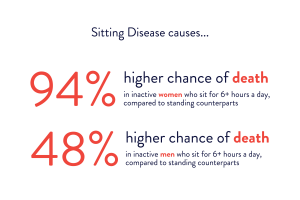
Sitting is something so commonplace we often don’t realize just how much of our day is truly spent sedentary. However, sitting for too long can have many negative impacts on health and longevity. A 2011 study in the American Journal of Preventative Medicine found that prolonged sitting was associated with an increased risk of 34 chronic diseases including obesity, diabetes, cancer, and cardiovascular disease. Yikes!

A typical American is sedentary for 21 hours out of the day. Including exercise and physical activity, people across the U.S. only spend approximately 3 hours out of the day simply standing.

This phenomenon has been coined as “Sitting Disease,” which, broadly speaking, is defined as a condition of increased sedentary behavior associated with adverse health effects. Sedentary behavior can be defined by two things: the position you are in, which is generally reclining or sitting, and the amount of energy expenditure that your body is experiencing.

You may be asking yourself, “But I work out every day, does this still apply to me?”

Unfortunately, according to The Journal of Medicine and Science in Sports and Exercise, the “Active Couch Potato” phenomenon states that even an active person who works out five times a week still faces the risks associated with “Sitting Disease” if they are living a sedentary lifestyle outside of the gym. Unfortunately, you can’t undo eight plus hours of sitting with a workout!

Although participating in moderate to vigorous exercise 3-5 times a week is recommended, it’s important to start with the first step: standing. Dr. Brian Liem, MD, FAAPMR, from UW Sports Medicine, says that a “lifestyle of prolonged sitting is distinctly different even from a lifestyle absent of routine exercise.”

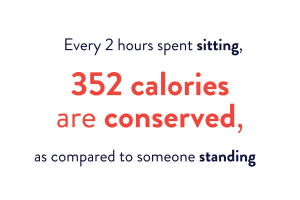
A study at Mayo Clinic found that for every 2 hours spent sitting 352 calories are conserved as compared to someone standing. Dr. Liem emphasizes that “standing can help get some of that metabolic activity back up because standing causes contractions in your postural muscles in your back, hips, and knees to keep you upright.”

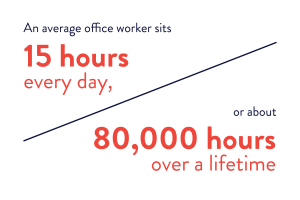
The majority of Americans stare at a computer screen during the day, whether it be at an office desk or at home. If not, we are looking at the computer in our pockets – our smartphones. An average office worker sits for 15 hours every day, which calculates to about 80,000 hours spent sitting over a lifetime.

Technology has become an accepted part of our everyday lives, but that doesn’t mean we shouldn’t be cognizant of what our bodies are doing while we are using technology.

Staring at your computer with poor posture causes the development of a hump at the top of your back, the shortening of your hip flexors, shortened abdominal muscles, a caving chest, weakened shoulders, arm pain, numbness and tingling in your extremities, and worst of all, traumatic pressure on the disks in your back. All of these symptoms are not uncommon.

Good posture is also important when using a smartphone because a human head weighs about 10–12 lbs. Studies show that bending your head down to the 60-degree typical texting position can make your head weigh about 60 lbs. We spend about 700 – 1,400 hours on our smartphones every year, so putting that much stress on our necks and spines just by bending our heads for that long can start to develop problems.

So, what are some solutions?

We know that it is difficult to be removed from technology and that many common solutions can be expensive or difficult to find on the market. Instead, we emphasize the importance of awareness in terms of your posture, bodily movement, and the amount of sitting/reclining per day.

For every hour of sitting, try to get about ten minutes of standing in. For every 30 minutes that you are doing work, there should be 20 minutes of actual computer work, and then a 10-minute break. That 10-minute break should be 8 minutes of standing and 2 minutes of stretching. This alone is a pretty big change from sitting for hours on end, and should over time give back to your body exponentially.

Incorporate movement breaks into your day

Check out the Whole U’s Flex at your Desk and Stretch at your Desk handouts to learn a few movements that you could try at work. We also encourage you to join The Whole U’s daily movement class at 11 a.m. 15-minutes of stretching and light movement to give your body a much needed sitting break.

When you are sitting, think of an ergonomic posture – bringing your keyboard and mouse closer to your body, keeping your shoulder blades pulled back, relaxing your elbows by your side, and maintaining a neutral spine. The Whole U’s Working with Better Posture handout is a great place to start.

Learn more by watching 2 recorded webinars

Working Ergonomics with Dr. Peter Johnson

Join Dr. Peter Johnson, Professor Emeritus, Environmental and Occupational Health Sciences, and Adjunct Professor of Industrial and Systems Engineering to learn everything you need to know about creating an ergonomic workspace—wherever you’re working! Click here to download Dr. Johnson’s updated slides. 

Sitting Disease Deep Dive with UW Sports Medicine

Elliot O’Connor, DPT, and Dr. Brian Liem from UW Sports Medicine share information about what sitting disease is, how it can lead to chronic back and neck pain, and provide some simple exercises that you can do to prevent and beat the sitting disease.

Small steps can make a big difference – literally!

You can also combat “Sitting Disease” through small things. Try parking farther away, standing while you eat lunch, and doing one-leg balance stances while you watch television or brush your teeth. Every little step you take is one less moment spent sitting.

Alongside standing, aerobic exercise is extremely important. As recommended by the HSS, you should be performing a minimum of 30 minutes of moderate intensity aerobic activity about 5 days a week or 20 minutes of vigorous intensity aerobic activity about 3 days a week.

Top 10 ways to properly fuel your body

Nutrition trends can have a major influence on us as we navigate our overall health and performance. We are eager to try the latest nutrition trend that shows up on our social media feeds or the newest supplement or diet that claims to be life changing.

That’s why we asked Judy Simon, UWMC dietitian, about fad diets and trendy supplements. She had three common observations:

  1. They are not sustainable in the long term
  2. They can be very expensive, and
  3. They often lack the varied nutrients our bodies need.

But Simon is seeing at least one positive nutritional trend: a tendency toward eating more plant-based or plant-forward meals—for both health and sustainability.

“You don’t have to be strictly vegetarian to gain the benefits of a plant-forward diet,” she says. “More fiber improves gut health. Optimizing gut health not only helps people feel better now, it also contributes to preventing and managing many chronic diseases. It’s exciting to see a trend towards more fruits, vegetables and whole grains.”

Simon advises making small changes that will have a big cumulative impact on your overall health over time. Being more mindful here and there about the food we eat can set the groundwork for other sustainable wellness goals while helping us feel energized and ready to take on the day.

She adds that the secret to a healthy, balanced diet is really no secret at all. It is simply understanding your body’s needs and finding what works for you. Here, Simon shares her top 10 tips to make a habit of healthy, mindful eating.

1. Get excited about nutrition

Healthy foods are often assumed to be boring and flavorless. With this assumption, it can be hard to be inspired to eat healthy. “Healthy eating is not about being on your best behavior,” Simon says. “It’s about finding delicious alternatives that you will crave. Nutrition is always an easier sell if you link it to food and how wonderfully tasty it can be and how good it makes us feel.”

2. Eat more plant-based foods

Plant-based foods are perfect for providing energy. Simon champions certain carbohydrates for providing energy, such as grains, whole wheat, quinoa and beans. Additionally, fruits, vegetables, seeds and nuts are going to provide energy as well. It is important to note that energy needs will differ depending on the person.

3. Know the difference between hunger and thirst

Water is great for helping with digestion, slowing down fast eaters and providing our bodies with energy. Unfortunately, Simon cautions us that, “a lot of times people mix up their signals for whether they’re hungry or thirsty. If this is true, eating food typically isn’t going to satiate that hunger.”

The real trick to knowing whether you’re hungry or thirsty is reading your body. Take a second and ask yourself when is the last time you drank a cup of water? With a meal, Simon recommends having at least 8-12 ounces of some type of fluid—ideally water-based—then continue to sip throughout the day.

4. Keep a meal log

“For someone who is curious about how they’re doing, eating logs are a really good starting point,” Simon explains. “When you start to enter things in, you become more aware of your habits and notice eating trends you otherwise wouldn’t.”

For example, a lot of us overestimate how many fruits and vegetables we really eat, until we look at our typical day. Phone apps can be helpful for this, but it is important how we interpret the information they give us. Sometimes eating logs can do more harm than good if we are too hard on ourselves. It’s all about finding balance.

5. It’s all about greens and beans

Not sure what exactly to eat? Go for the greens and beans! Greens and beans such as lentils, legumes, and beans, are a great source of protein and fiber. Thirty percent of a bean or lentil is protein! Soy, edamame, and lentils are also more affordable sources of protein if you’re looking to eat healthy on a budget.

“Beans have iron, fiber, magnesium, and so many other good nutrients! Greens as well have great amounts of folic acid, iron, potassium, and Vitamin K. Greens and beans are perfect for whipping up a variety of meals with many different combination options!”

6. Incorporate healthy fats

Healthy fats are a great addition to every meal because we need the fat to absorb some of the vitamins from our greens and beans. “Adding in a little fat like a small bit of olive oil, seeds, nuts or avocado is a great source of fat and energy,” Simon says. “Obviously, we don’t want too much, but it’s a great source of energy!”

7. Front-load your energy with breakfast

For those of us who have a busy day where we need to be alert and on our toes, front-loading our energy by having a fulfilling breakfast is the perfect way to fuel. If you swear you can’t eat anything before noon, try and see the difference in how you feel. There are so many options for a filling breakfast, whether you eat the minute you wake up, take it on the go, or wait until you’re sitting at your desk.

“It doesn’t have to be a traditional breakfast! It can be leftover dinner for breakfast, a little wrap with veggies, hard-boiled eggs, or a power bowl,” Simon says, cautioning that, “skipping breakfast can be bad if you don’t eat for several hours after waking up. You’re putting your body into starvation mode after a long fast and then it wants to hang onto fat. This makes you want to eat more later.”

8. Read your labels

Food labels not only tell us the nutrients in our food, but also each individual component. Simon recommends comparing the nutrition label with the ingredients and really thinking about what is added and what is from a whole food. For example, sometimes you’ll read a label and it has sugar hidden behind five different ingredients. With sugar, really look to see if the sugar is added versus part of a key ingredient such as fruit.

A common misconception with labels is that frozen foods are all bad. When things are out of season, Simon says it is okay to eat frozen. Most frozen fruits and vegetables are picked at the time of freshness and immediately frozen so they’re not processed. Watch out for the sauces, and don’t forget to look at the label for sneaky additives!

9. Pack and plan ahead

Packing ahead saves time and money. We all have those moments where it’s the afternoon and we’ve already eaten our lunch but need a little something to tide us over so we buy a bag of chips and dig in. This won’t give us energy or help us last until dinner.

Instead, pack ahead stable foods that provide energy and don’t need refrigeration. Whether it’s an energy-packed granola bar or a peanut butter sandwich, these snacks require less effort to maintain, but give us that much needed boost.

10. Know your environment

Sometimes we don’t have a choice where we eat, but when we do, make the decision to not eat distracted. The worst place we can eat a meal is on the couch with the television on. Challenge yourself to clear off a counter and eat with purpose. Focus on how the food tastes and whether it’s meeting your nutrition needs.

“You don’t need a traditional dining room,” Simon says. “Turn off the devices and make eating a fun, sit-down experience. If you’re by yourself, put on some music. Do something that creates a space to focus on your eating. You’ll feel more satisfied and improve your digestion.” With spring just around the corner, it’s even better to get outside if you can!

Learn more

Healthy living is all integrated. Simon says simply asking ourselves, “what am I doing for self-care?” can go a long way toward helping us recognize our food patterns: “Have confidence and build on the skills that you have when it comes to eating healthy. Don’t feel like you have to be an amazing chef to cook a good meal. Start simple and experiment”

Judy Simon has presented for The Whole U many times over the years. Below is her latest seminar on nutrition for optimal health.

Getting real about financing college

Your mind may have been boggled by the recent headline declaring that the full cost of attaining a four-year degree at a few of the nation’s elite universities is about to surpass $400,000 for the first time.

Of course, few students will actually pay this astronomical sticker price. And higher education costs quite a bit less at the vast majority of schools.

But the reality is: a college degree is expensive anywhere. Especially when you factor in room, board, fees, books, technology, supplies and travel as well as tuition.

According to the Education Data Initiative, the average annual total cost for a student attending a private university is now $58,628 (including $38,768 in tuition).

The average annual cost for an in-state student at a public university is $27,146 (including $9,750 in tuition). For out-of-state students, that average annual cost at a public university rises to $45,708 (including $28,386 in tuition).

That puts the University of Washington above average for both kinds of students. The total annual cost for in-state students is estimated at around $35,000 (including $11,869 in tuition). The total estimated annual cost for out-of-state students runs closer to $66,000 (including $42,105 in tuition).

These costs are not standing still. EDI reports that the price tag for higher education in the United States has doubled since the turn of the century, rising at rate greater than 4% per year. And there’s no sign that this growth is going to slow.

That’s the scary part. But there are many strategies to reduce the cost of higher education. We asked our partners at BECU to help get you started on economizing college. Your dreams of sending your kids to college are not impossible. With some smart saving and savvy planning, you can make it happen.

Start saving early

The best way to ensure you have enough funds for your children’s higher education is to start saving as early as possible. Thinking about higher education expenses when your children are still young may seem unusual. However, the earlier you start, the more time you have to save and plan. Even small contributions can add up over time and make a significant difference in covering the cost of higher education. Here are some education savings strategies to consider:

529 Plans – tax advantaged savings plans designed to save money for approved higher education expenses including tuition, fees, books, supplies and room and board. 529 plans can be used at any public or private college, university or technical school in the United States (and even some foreign colleges). They come in two types:

  • 529 education savings plans – investments grow tax-deferred, and withdrawals are tax-free when used for qualified education expenses. Washington state’s 529 education savings plan is called Dream Ahead.
  • 529 prepaid tuition plans – allow you to prepay all or part of the costs of a college education to essentially lock in future tuition costs at today’s prices. Washington state’s 529 prepaid tuition plan is called GET (Guaranteed Education Tuition).

Coverdell Education Savings Accounts – also known as an Education Savings Account (ESA), is a tax-deferred account where earnings and distributions are tax-free as long as the funds are used for educational purposes. The maximum annual contribution limit is $2,000 per year per student.

Traditional savings and CD accounts – though they lack tax advantages, the put the power of compound interest to work for you, meaning you’ll earn more money on your savings over time.

Economize college

Cut unnecessary expenses – review your current monthly expenses and identify areas where you could cut back to free up extra cash for your children’s higher education. It could be as simple as eating out less, canceling unused subscriptions, or finding more budget-friendly entertainment options.

Create a budget – a detailed monthly budget can help you track your spending and identify areas where you can save. Make sure to include all your expenses, including groceries, utility bills and other necessary expenditures. Stick to your budget and find ways to save even more each month.

Consider a side hustle – look for creative ways to increase your income. Consider taking on a part-time job or picking up a side hustle. Many people earn extra income through gig economy driving and delivery jobs or by freelancing, selling items online, providing tutoring or pet-sitting services

Calculate the real cost of a degree

Average costs only get you so far in calculating how much money your family is going to have to pay for higher education. Higher education comes with a wide variety of price tags.

Before you get too far into the math, take some time to talk to your student(s) about their educational goals. Do they dream of a bachelor’s degree? Or would a vocational degree better suit their career goals? Do they know what they want to study? Or do they need more time to figure out what they want to major in?

A group of young college graduates poses in cap and gown.

Once you start considering particular schools, it’s important to note that the price a given student or family pays for tuition can vary dramatically based on demonstrated need and merit. Universities determine financial ad packages for each accepted student based on the information in the FAFSA (Free Application for Federal Student Aid). Some private universities also use College Board’s CSS Profile for decisions on need based financial aid awards.

When making decisions, remember to consider the full cost of education. Tuition gets most of the attention, but it’s important to calculate the full cost including fees, on-campus room and board or off-campus housing and food budget, books, computer, supplies, travel and other miscellaneous expenses.

That’s the bad news. The good news is that there are many opportunities for need and merit-based grants and scholarships to also factor into the net cost of education. More on these below.

Got get a realistic picture of what higher ed might put you back, many universities publish their own online cost calculators, in which you can customize your own student’s situation. There also are more general cost estimators available on many financial and government sites such as becu.org and  USA.gov.

Explore financial aid options

There are many ways to reduce the cost of higher education, including three primary types of financial aid: loans (which have to be repaid), grants and scholarships (which don’t have be repaid) and work-study employment that lets students earn money and gain job experience while they’re in school.

The amount and type of financial aid offered is based on two factors: merit (scholastic, athletic, musical, etc.) and financial need.

About two-thirds of full-time undergraduate college students receive some sort of financial aid. To find out if you’re eligible, you need to fill out the FAFSA and possibly the CSS Profiles.

Government Loans are borrowed money that have to be repaid with interest. They are generally a better deal than private loans due to a lower fixed interest rate, more flexible repayment terms and potentially deferred payments. Two forms of government loans are:

  • Stafford loans – used to supplement personal and family resources, scholarships, grants and work study. They may be subsidized (interest payments are waived while your child is in school) or unsubsidized (interest accrues during school).
  • Parent PLUS Loan – can cover more of the cost of education than a Stafford Loan, but they have higher-interest rates and are only available to parents of enrolled students.

Government Grants are awarded by federal, state or local governments. They are often need-based and do not need to be repaid. Examples include the Federal Pell Grant, Federal Supplementary Educational Opportunity and the Teacher Education Assistance for College and Higher Learning (TEACH) Grant.

Scholarships are available through a variety of organizations, including universities, employers, individuals, nonprofits and religious and professional groups. Scholarships can be a good resource for families that have too much income to qualify for federal financial aid, but not enough to pay for school without assistance.

If you have a student in the Seattle Public Schools system, you might consider the Seattle Promise program. Seattle Promise provides graduates of Seattle public high schools tuition-free education at three Seattle Colleges—North Seattle, Seattle Central and South Seattle—for up to two years, 90 college credits or the student’s first degree, whichever comes first. Eligibility for Seattle Promise does not consider GPA, income, ability or country of birth.

Consider alternative pathways

If you are like most families, at some point you will need to involve your children in a reality check. Compare the prices of different schools. Maybe your child dreams of attending an Ivy League school but doesn’t want to be paying off a student loan 25 years from now. Maybe there is a comparable experience to be found at a less expensive private or public school.

It is also important to consider that there may be better options than a traditional four-year college for some young people. For some young people, trade or vocational schools offer specialized training and qualifications that can lead to well-paying jobs and satisfying careers.

Daunting but doable

In conclusion, paying for your children’s higher education can seem daunting, but it is achievable with planning and changes to your spending habits. By starting early, cutting unnecessary expenses, creating a budget, and exploring financial aid options, you can alleviate some of the financial burdens of college. Remember to involve your children and consider alternative pathways if necessary. With these tips, you can help set your children up for a productive and independent future.


Find many more great tools to maximize your financial health at BECU’s Get Money Smart site or blog.

Raising healthy kids in a digital world

Five young adults smiling for a selfie

As a tween or teen, it can be difficult to navigate the complexities of social media. These strategies can empower parents and caregivers to create a realistic plan for their family’s screen use.

Parents and caregivers of tweens and teens can’t fail to have seen—probably on social media—a recent report from the U.S. Surgeon General about the “profound risk of harm” to adolescents’ mental health and well-being caused by excessive use of social media.

“Parents tell me they watch their children retreat to their bedrooms and spend hours alone with their screens,” wrote the Surgeon General in the Washington Post, “exposed to an endless feed of flawless bodies and unrealistic ideals.”

The report substantiates what many researchers, doctors, parents and lawmakers have long suspected about social media use in youths, elevating the conversation of how to address the issue to the national level.

And it is indeed an issue: a 2022 Pew Research survey found that 95 percent of teens said they had daily access to a smartphone, while 35 percent said they were using at least one of the top five social media platforms (YouTube, TikTok, Instagram, Snapchat and Facebook) “almost constantly.”

According to Screen Sanity, a national nonprofit focused on digital health for youth, 80% of teens check their phones throughout the night and respond to every notification.

That’s a lot of lost sleep.

Clinical diagnoses and self-reporting among adolescents of anxiety and depression, along with emergency room visits for self-harm and suicidal ideation, have risen in recent years in a seemingly parallel pattern with increasingly prevalent use of social media.

But the correlation between social media use and increasing rates of distress among young people is unclear.

Recent research considering the connection between social media and youth well-being has been consistently inconclusive, demonstrating both a positive and a negative effect: while excessive screen time of any kind disrupts sleep and can supplant activities like exercise, reading and other hobbies, social media use has allowed countless youths to connect with a community and express themselves.

There is a correlation between time spent on social media or in online gaming and monetary cost as well. Alexis Hiniker, associate professor at the UW Information School, has researched the prevalence in apps and games of “dark patterns”, interactive designs deployed in the ‘attention economy’ that encourage longer gameplay or reengagement with gameplay, ad viewing and making in-app purchases.

For kids who are still developing their digital critical thinking skills, coercive dark pattern design can result in hundreds of dollars spent on in-app purchases.

Earlier this year, the American Psychological Association issued its first-ever social media guidance recommendations, suggesting that parents and caregivers keep careful tabs on kids’ usage. The APA also suggested that tech companies producing apps like Instagram, TikTok and Snapchat reconsider features like endless scrolling and the “like” button.

What can we do to help our kids have a healthier relationship with screens and social media?

Dr. Dimitri Christakis, a leading child development expert and director of the Center for Child Health, Behavior and Development at Seattle Children’s, has said that screen time isn’t all inherently bad, and might even have some educational benefit for kids—as long as parents and caregivers are engaged in the curation and management of the content being consumed.

While this is particularly true for parents and caregivers of young children, engagement also goes a long way with tweens and teens.

Dr. Christakis suggests taking a highly active role in children’s media education by co-viewing programs with them and talking about them afterward—what was new, exciting or funny.

With older kids, playing video games with them and sharing fun and engaging apps and social media sites together—helping them to curate their feeds—goes a long way toward a healthier approach to its use.

It’s never a bad idea to remind kids that social media is a highlight reel

Of course, not all screen time is created equal. An hour spent watching a Minecraft gamer setting TNT on his opponent’s build, for example, is not equivalent to an hour spent video chatting with grandparents.

And for older kids, video chatting and text have become the standard means of socializing—so does that count as screen time?

“A lot of preteens and older adolescents do their socializing via screens,” Dr. Christakis said. “Texting and video chats have displaced talking on the phone, so I wouldn’t necessarily count that as screen time.”

Nonetheless, time spent socializing via a device is time not spent in healthy, face-to-face interactions developing real-life relationships—an essential skill for young adults.

Getting kids started with social media

For parents or caregivers considering when to allow their kids to begin using social media, note that the Children’s Online Privacy Protection Act prohibits companies from collecting data online from children under 13. Consequently, social media companies prohibit children under 13 from creating their own accounts.

Of course, the 12-and-under set can easily evade this rule by lying about their birth year—so it really is incumbent upon parents to help their kids navigate social media in positive ways.

Social media expert Devorah Heitner, author of “Growing up in Public: Coming of Age in a Digital World,” offers the following strategies in setting the ground rules for social media use for kids:

  • Create a family media plan to set expectations and check in with that plan regularly. Check out a sample “Media Time Family Pledge” for online media use.
  • Start slow: add new apps one at a time and give kids time to get the hang of how to use them and determine whether the app is a good fit for their personality and temperament.
  • Keep mealtimes and in-person gatherings free of devices to promote family bonding, meaningful conversations and authentic engagement.
  • Set time limits: when kids first get their own device, or first start using social media apps, don’t give them 24/7 access to it. Experts strongly discourage allowing devices in the bedroom at night, or phones used as alarm clocks—too much temptation.
    • You can set a limit via your own phone — on Apple look for the Family Sharing settings and on Android you can use an app called Family Link.
  • Prevent unwanted downloads with an Ask to Buy setting on Apple phones that will send a request to the parent when kids want to buy or download a new item.
  • Help your teen understand and curate their feed by encouraging them to like and follow a diverse group of role models—peers, celebrities doing good works, athletes encouraging positive change in the world.
  • Talk to your kids about who they follow and why and share the same about your own social media accounts. Be sure they understand your boundaries around content and how—and why—to keep their personal information private.
  • Define “sexting” to kids of all ages and make sure they know that it is never ok to send or receive pictures of people without clothing, whether they know the person or not.
  • Resist the urge to take away their device or access to social media if they post something you don’t like, which can backfire if kids go “underground”. Instead, talk with them about deleting a poorly planned post and repairing any damaged relationships.
  • For younger children, consider Pinwheel, a smartphone with multiple built-in parental controls, including the ability to monitor your child’s communications.

Helping teens wean off social media

What if your tween or teen already has a device and access to social media—and is one of the 35% checking apps “almost constantly” and suffering the negative mental and physical health consequences of it?

Much media coverage has been allotted to “tech’s toxic effect” on self-esteem—particularly for girls. Considerably less media suggest how parents and caregivers can help kids wean themselves off or cut back on social media—especially when social media platforms and apps are designed to be both addictive and deceptive.

Jean Twenge, a psychologist at San Diego State University who has extensively researched the effect of social media on teens’ mental health, has some suggestions for helping them cut back:

Set boundaries collaboratively by asking your child what kinds of changes feel manageable, such as cutting down on the number of apps available or limiting overall social media time. Consider using the American Academy of Pediatrics’ free tool for creating a family media plan.

Suggest a social media vacation: a day, a week, a month—any time off from social media can be beneficial to teens. Expect pushback, and be prepared to offer alternatives for the time they would have spent scrolling: a family outing, such as a special shopping trip or visit to a theme park or family fun center, might be just the thing.

Stay firm on your own rules around the amount of screen time teens are allowed, keeping screens out of the bedroom at night and turned off during mealtimes. Like any aspect of parenting, consistency is key.

Additional resources

Bright Horizons + Screen Sanity: UW WorkLife’s employee backup care provider, Bright Horizons, has partnered with Screen Sanity to offer a comprehensive webinar, Improving your family’s digital wellness, to empower parents and caregivers  to create a plan for their family’s screen use, introducing kids to smartphones and safely introducing social media.

Looking for additional support navigating screens or social media with your family? UW’s employee assistance program, Washington EAP, has a variety of resources available to parents and caregivers, including parenting articleswebinars and counseling (available for both parents and caregivers and children).

How to take parental leave: tips from your UW Human Resources leave specialists

So, you’re expecting a new child, either through birth or adoption. Congratulations! It’s wonderful news, but also one of the biggest life events that can come along. Here are tips for taking time away from work to bond with the new member of your family.

What are my leave options?

Erin Rice, assistant vice president of UW Human Resources Campus Operations, says that parental leave is complicated by multiple overlapping state and federal laws, UW policies and union contracts that play into the amount of time you can take off and the means of getting paid during your leave.

“The good news,” she says, “is that there are a lot of options, and UWHR has resources and people to help you understand and navigate your options.”

Below, Rice and her team answer the most commonly asked leave questions.

What are the different components of parental leave?

Birth parents can take 6 to 8 weeks for temporary pregnancy disability, or as prescribed by a health care provider, immediately following the birth. Bonding leave starts after the disability period for birth parents, after birth or placement for non-birth parents.

What government policies affect my leave?

The federal Family & Medical Leave Act (FMLA) is a leave entitlement that provides job and health insurance protection when eligible employees take a leave of absence for a qualifying reason. Eligible employees have worked for the UW for at least 12 months and 1,250 hours.

The Paid Family & Medical Leave (PFML) program is a program of the state of Washington that provides partial wage replacement for employees on qualifying leave who have worked in the state of Washington for 820 hours during the “qualifying period.”

How long can I take leave?

Under UW policy, union contracts and civil service rules, parental leave (after post-birth parent disability) is 4-6 months, depending on which policy or contract applies to you.

For FMLA-eligible parents, the FMLA period (12 weeks minus any FMLA you have used within the last year) runs concurrently with pregnancy disability and parental leave. FMLA is not a separate leave period.

PFML-eligible birth parents can receive up to 16 weeks benefits (up to 18 weeks if you have pregnancy complications). Non-birth parents can receive up to 12 weeks.

Do I have to take leave all at once?

UW Parental Leave is generally taken as continuous (full) leave of absence or, if it meets business needs and has the approval of your unit, can be granted as intermittent leave or a modified work schedule.

Leave covered by PFML can be taken intermittently or on a reduced schedule for the 12 months following the date of a child’s birth, adoption or placement.

How do I get paid?

If you accrue paid time off, you can be paid while on leave by using your paid time off or through parental shared leave. For parental shared leave:

  • Donations from other UW and state employees can be used once your Vacation Time Off and Sick Time Off balances in Workday are each reduced to 40 hours or less.
  • Birth parents can use donated time during disability period + the following 16 weeks.
  • Non-birth parents can use donated time for the 16 weeks immediately after birth or placement.

Faculty can use available paid sick leave to care for the birth parent by following the process to request leave to care for a family member.

It is also possible to take approved leave as unpaid time off.

Through PFML, the weekly benefit amount is generally up to 90% of weekly wages, with a $100 per week minimum and a $1,456 per week maximum (2024).

During a PFML leave, it is the employee’s choice whether to use accrued paid time off. Employees can receive both paid time off from the UW and the PFML benefit for the same period. This is called using “supplemental benefits.”

How do I maintain health benefits while on leave?

If you have worked for the UW for 12 months and 1,250 hours prior to taking parental leave, your health insurance benefits continue just as if you were working during FMLA and PFML.

After your FMLA and/ or PFML is exhausted, or if you are not eligible for FMLA or PFML, you will need to remain in “pay status” to maintain your benefits.

Pay status means that you either use eight hours of paid time off or work eight hours a month.

The UW Benefits office can help with additional questions regarding benefits. And UW WorkLife offers a wide range of other child care resources.

How do I request leave?

All staff and academic personnel complete and submit a parental leave form. Request the entire period you would like to take parental leave in Workday (see Leave of Absence – Sick/Injured or Becoming a Parent User Guide) at least 30 days prior to birth/placement. After approval, request time offs (sick, vacation, unpaid) for each day of your parental leave in Workday.

Parental shared leave is requested by checking a box on the parental leave form.

PFML is requested through the Employment Security Department.

Who can I contact for help with family leave?

Campus staff and academic personnel – hrleaves@uw.edu

Medical Centers staff – medctrfmla@uw.edu

Students – uwdrs@uw.edu/TitleIX@uw.edu

“The most important thing to know is that you should not hesitate to reach out to our leave specialists at hrleaves@uw.edu to discuss any of these issues and how they relate to your leave situation,” Rice says. “They can answer questions by email or over a meeting on Teams or Zoom. They want to help you get your questions answered so you can get on to enjoy being a parent!”

Online resources

UWHR – https://hr.uw.edu/ops/leaves/parental-leave/

Pregnancy Accommodation – https://hr.uw.edu/policies/pregnancy-accommodation/

PFML – https://hr.uw.edu/ops/leaves/paid-family-and-medical-leave-pfml/eligibility-and-benefits/

Academic Personnel – https://ap.washington.edu/ahr/working/leaves/leaves-for-becoming-a-parent/

Students – https://www.washington.edu/titleix/pregnant-parenting/

UW Benefits – https://hr.uw.edu/benefits/

UW WorkLife – https://hr.uw.edu/worklife/child-care-and-caregiving/

For more information, you can watch this new panel discussion on navigating leaves and benefits for new caregivers:

Many hungry Huskies: food pantries fight rising food insecurity across the UW

“We have all the data,” says Ellie Green, student director of the UW Food Pantry, as she pries open a thick ring binder packed with spreadsheets, charts and graphs tracking every aspect, in minute detail, of the essential campus resource she manages. Sources of food. Volunteer hours. Donations. Food drives. Quantity distributed.

But one data visualization in particular paints a strikingly vivid—and vertiginous—picture of the situation the pantry is addressing. The trend line of quarterly visits rises steadily for the past few years before skyrocketing last fall, when the pantry hosted more than 6,000 visits. That is a tripling of demand in just five years.

“It’s hard to think about your future if you don’t have food on your plate now,” Green says.

Fortunately, free food distribution centers are ramping up to meet the exploding need on all three campuses with determination, resourcefulness and extreme empathy. They are the UW Food Pantry in Seattle, the Husky Pantry at UW Bothell and The Pantry at UW Tacoma.

Every dollar makes a difference.

By the numbers

The most recent National Postsecondary Student Aid Study by the U.S. Department of Education found that 23% of undergraduates and 12% of graduate students experienced food insecurity in 2020—rates higher than the general public. The study also revealed that 35% of Black students, 30% of Indigenous students and 25% of Hispanic students experienced basic needs insecurity.

In a more localized 2019 study by Urban@UW, 20% of UW Students reported that they often or sometimes ran out of food and lacked the money to buy enough to eat.

Judging by each UW food bank’s recent accounting, the need has only grown since pre-pandemic days.

The UW Food Pantry served the university’s largest campus community at a rate of 600 visits per week last quarter, which has continued to increase through the first month of 2024. The Pantry at UW Tacoma is now serving 100 students a week, according to manager Dalia Susana. And visits to the Husky Pantry at UW Bothell have doubled each quarter over the past year, reaching more than 420 in the fall “and we continue to be just as busy in the new year,” says Heather Kenning, manager of UW Bothell’s Basic Needs Program. “We have started seeing a major increase in usage.”

Economic conundrum

The recent expansion of campus food insecurity comes down to basic economics. High inflation, supply chain woes, rising labor costs, insufficient housing and other fiscal forces have sent the costs of rent, fuel, food and basic necessities soaring in the Puget Sound region.

Although systemic racial inequities make populations of color most susceptible, just about everyone is feeling the pressure on their budgets. And students tend to be especially vulnerable.

It is a myth that college is a bastion of the affluent and entitled alone. In reality, many students live on an economic razor’s edge, surviving on financial aid, loans and other campus resources that can often run out. Savings are often minimal. Work hours can be limited by the demands of schoolwork. And students often don’t qualify for benefits through the federal Supplemental Nutrition Assistance Program (SNAP).

At UW, the large population of first-generation students face extra financial challenges, according to Green. “The reality is that people go to college and try to make it work for the promise of a better future. But the resources available are not always sufficient.”

Beyond the stereotype of the “starving student” who eats only ramen, Kenning says that the unique economic situation in our region shines a spotlight on how inflation and the extreme rise in the cost of living are impacting students. “Food insecurity in our community means students are having to make tough choices about housing, tuition and groceries,” she says, “while keeping up with school.”

In this equation, food is often first to be sacrificed.

Critical community resources

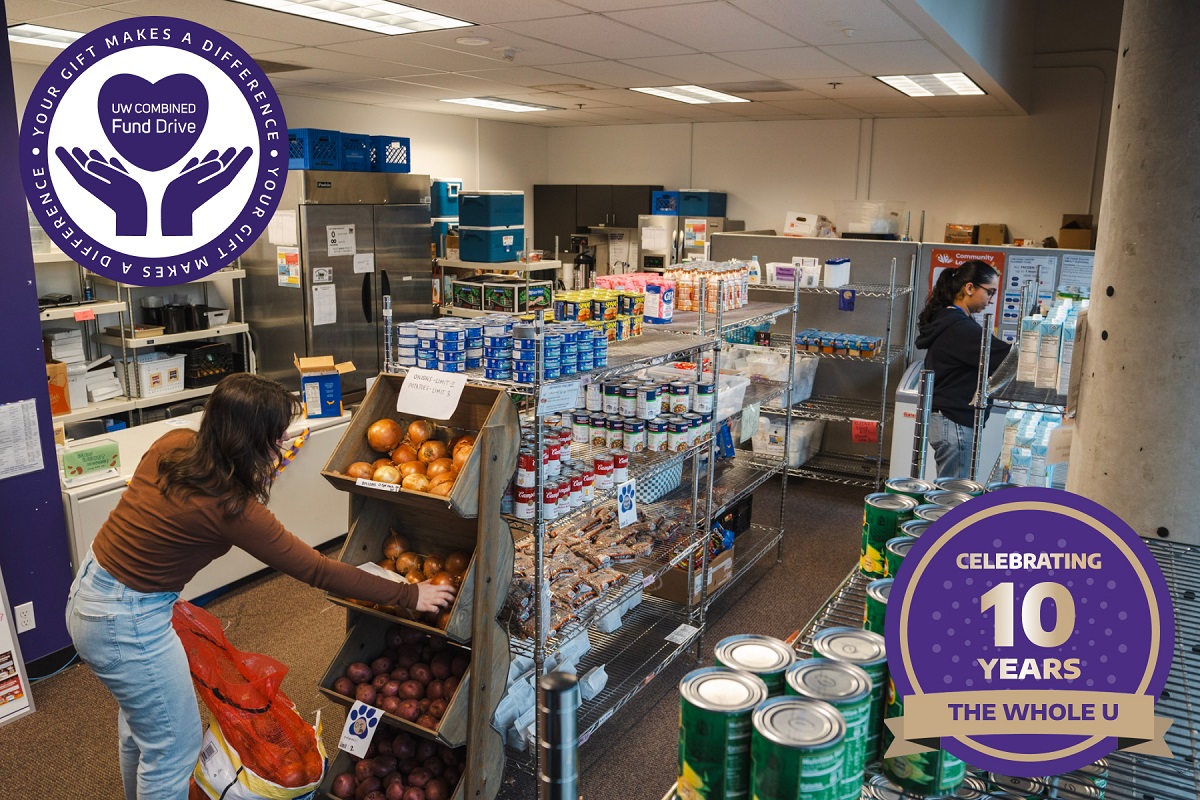
On a weekday in January, the wire shelves of the compact UW Food Pantry are stacked with canned goods and bags of rice, oats, dried noodles, flour and dried beans. Bins of onions and potatoes are filled from 50-pound bags. A double-wide refrigerator is stocked with milks, salads and ready-to-eat meals. Another shelf displays hygiene products, diapers, Covid tests and Narcan doses.

Food drive coordinator Harmony Tinley, student director Ellie Green and volunteer Riya Lele at the UW Food Pantry.

The Seattle campus pantry collected and distributed nearly 40,000 pounds of grocery products last quarter alone. Inventory derives from contributions to the Any Hungry Husky Fund (44%), food drives (19%), individual food donations (12%), food recovery from UW Housing & Food Services and on-campus retail partners (10%) and Northwest Harvest (8%). Additionally, an organization called Community Loaves delivers fresh baked bread and cookies twice a month. And the high demand for fresh produce is boosted in season by twice-weekly deliveries from the UW Farm. “Overwhelmingly, folks want produce,” Green says. “But they’re also looking for staples. It seems simple, but with prices going up, they hold people over longer.”

This complicated operation is orchestrated by an overlapping team of four part-time staff (Green is a graduate student at the Evans School of Public Policy) and upwards of 80 volunteers each week.

They communicate on social media, coordinate food drives, receive and process donations and source food from local establishments. “Our team is fantastic,” Green gushes. “I can’t say enough about them. They are so passionate and problem-solving and collaborative. And then we have amazing volunteers who bring energy and potential solutions to our challenges. We’re trying to level everyone up.”

The fuel to thrive

With the need growing so rapidly, each of the pantries are struggling to keep pace. Doing so will require increased donations of cash and food, via drop-offs, food drives or even Amazon orders. And they need more volunteer hands to keep the shelves stocked and the community served.

“Helping us keep our inventory is our biggest need,” says Kenning. “Hosting food drives or donation drives are extremely important in helping us keep up. We do a pretty good job as a campus community rallying to support the Husky Pantry, but having assistance from people who can leverage their community resources helps us expand our reach.”

The Pantry at UW Tacoma’s would benefit from contributions of time and food items. But the greatest need is “funding, funding, funding,” according to Susana. “Due to budget cuts, we have lost many of our donors, vendors and funds. We know that the volunteers will show if we have the need for them, which will be when we increase our funding.”

Riya Lele, a student volunteer, stocks shelves in the UW Food Pantry.

Green at the UW Food Pantry echoes the call of her colleagues. “We rely on donations. Food drives—in person or virtual—are really impactful. And spreading the word is really important.”

That includes advocating for more resources from Olympia addressing food insecurity on UW campuses.

“More awareness is always my answer,” Green says.

Because these pantries are providing an essential resource, making miracles out of shoe-string budgets. “We provide food for students who are food insecure,” says Susana. “This allows them to get the necessary nutrients that they need to thrive in class and gives them the opportunity to be at the same level and mindset as their peeps.”

“For anyone affiliated with UW who is experiencing food insecurity, we are here to support you,” Green says. “We can’t provide everything. We’re one tool in a toolbox. “But we know that food insecurity is detrimental to health, impacts attention span, ability to concentrate—ability to do anything! We don’t want anyone to be hungry.”

Get to know your UW food pantries

UW Food Pantry

  • Established in 2016 as a series of pop-ups before moving into its permanent home in Poplar Hall in 2018.
  • Located in 210 Poplar Hall, 1311 NE 41st St.
  • Open Monday through Friday (various hours)
  • Offers shelf-stable and fresh food, baked goods, hygiene products, Covid tests, Narcan
  • Serves UW students and staff (with UW ID); one visit per week to receive 2-3 days of food

Husky Pantry at UW Bothell

  • Founded in 2016 as an initiative through the Student Diversity Center; now part of the Health and Wellness Resource Center (HaWRC).
  • Located in 120 ARC (Health and Wellness Research Center)
  • Open Monday through Thursday, 10 a.m. – 4 p.m.
  • Offers grocery staples, seasonal products, hygiene and toiletry items (all non-perishable)
  • Serves UW Bothell students (with UW ID)

The Pantry at UW Tacoma

  • Created by the Center for Equity and Inclusion in 2013 in response to a survey revealing that 40% of UT Tacoma students were food insecure.
  • Located in 104 Dougan Hall; moving to 010 William Phillip Hall (WPH) on Feb. 16.
  • Open Monday through Friday, 10 a.m. – 4;45 p.m.
  • Offers shelf-stable and perishable food accommodating different dietary and cultural needs plus hygiene items.
  • Serves UW Tacoma students (with UW ID); one visit per week; up to 20 items per visit.

How to give or get help

Visit the websites of the UW Food Pantry (Seattle), The Pantry (Tacoma) and Husky Pantry (Bothell) to learn how you can access their services or support their work through donations of money, food or time.

You can also give financial support by setting up a gift through the UW Combined Fund Drive. University of Washington Husky Hunger Relief (); University of Washington Tacoma Pantry (#); University of Washington Bothell Food Pantry (#

Volunteering is good for the world—and good for you

Volunteering is a fun way to support your favorite nonprofit organization – plus, research demonstrates that it’s good for you. Whether you are able to volunteer on a regular basis, or just have the occasional hour or two to spare, you can support a cause you are passionate about.

Why volunteer?

Volunteering is good for you. In study after study, researchers have found that people who volunteer lead longer, healthier, happier lives. Volunteerism correlates positively to stronger self-confidence, better quality of friendships and improved job prospects.

Volunteering connects you with others and builds more robust social networks. Feeling lonely? Volunteer! Want to make some new friends? Commit to a shared activity with someone, and watch your friendship blossom. Bonus: because volunteering often helps people discover their passions, it also helps develop the ability to tell one’s own story.

Volunteering fosters a sense of purpose. Giving your time and energy with no expectation of compensation – that is, being altruistic – gives meaning to one’s life. Particularly for those undergoing a life change such as retirement, empty nest or the death of a loved one, volunteering can help relieve stress, improve self-esteem and promote emotional stability.

Volunteering is good for your career. Volunteer experience on your resume demonstrates to potential employers that you can take initiative, overcome challenges and learn new skills. Significantly, volunteering can grow your professional network and may even lead to your next job.

Volunteering financially supports organizations. In Washington state, each hour you volunteer saves a nonprofit an average of $30.00 an hour.

Volunteering can build teams

Volunteering with work colleagues is a great way to bond over a shared experience. This is especially valuable in the era of hybrid work.

“One of my favorite things about being a volunteer coordinator for the Combined Fund Drive is having the opportunity to interact with members of our large department that I otherwise would not meet in my daily work,” says Brooke Emrich, program operations specialist in the Department of Laboratory Medicine and Pathology. “Whether they are asking me a question about how the CFD works, participating in a fundraiser or dropping off items for a drive that I am organizing, I love meeting people and also seeing the generosity of our department.”

Emrich enjoys highlighting the work of nonprofits, especially the ones she is passionate about supporting, like Facing Homelessness, PAWS and Solid Ground. In April, she’s organizing a group of departmental faculty and staff to volunteer for a 3-4 hour shift at Solid Ground’s Marra Farm as part of their annual celebration of Medical Laboratory Professionals Week.

More than just a “cool opportunity to spend time outside and learn a bit about growing food and farming while helping them keep the farm running,” she says she’s really “looking forward to the opportunity to get to know some of my fellow DLMP members.”

Ready to get working?

Below are a wide variety of local volunteer opportunities, put together in partnership with the UWCFD, that you can participate in on your own, with your family or with a group of coworkers.


Get outside

Washington Trails Association offers a variety of opportunities, from local one-day work parties to multi-day volunteer vacations, working to restore and maintain our state’s public lands.

In an effort to make all 2,500 acres of Seattle’s parkland healthy and accessible to all, Green Seattle Partnership offers a variety of local restoration, reforestation and work parties every week with over 1,500 events a year at 155 area parks.

Want to plant trees? Seattle’s Tree Ambassador program engages volunteers in leading educational tree walks, hosting tree stewardship events and planting trees with the Trees for Neighborhoods program.

Shark Garden: Located in White Center, this garden provides learning opportunities for students in the Highline School District and provided more that 2,500 pounds of food to the White Center Food Bank annually. Volunteer to help with garden maintenance, harvesting food for the food bank, construction projects, teaching classes, and more.

Outdoors For All is a national leader in delivering adaptive and therapeutic recreation for children and adults with disabilities. Programming includes snowboarding, snowshoeing, cross country and downhill skiing, cycling, mountain biking, kayaking, hiking, rock climbing, youth and adult day camps, yoga and weekend excursions.

City Fruit volunteers give their time in many ways to help support the mission of promoting the cultivation of urban fruit in order to nourish people, prevent food waste, and build community. Group and individual volunteer opportunities are available. Volunteer shifts are often on a Saturday for 2-4 hours and include training.

Puget SoundKeeper Alliance has weekly kayak cleanup patrols on Wednesdays from 11 am – 1 pm on Lake Union.

For animal lovers

Seattle HumanePAWS and Homeward Pet are great organizations that offer plenty of in-shelter volunteer opportunities such as clinic assistants and animal socializers. Seattle Animal Shelter particularly needs foster homes for dogs, cats and critters.

Seattle Veterinary Outreach, which provides free care for the pets of homeless people, has immediate need of medical staff and clinic support staff.

Want to be a puppy sitter? Summit Assistance Dogs’ single greatest volunteer need is for loving and devoted foster homes and sitter for their puppies and adolescent dogs training to become service pets.

Pasado’s Safe Haven needs volunteers for a variety of roles, including collecting and distributing donations at their pet food bank.

Little Bit Therapeutic Riding: Take care of the horses used for the therapeutic riding by grooming and tacking horses before class, supporting riders while in class, leading horses, and putting away horses after class. We encourage a weekly placement and ask for a commitment of at least six months.

Pet Partners is always looking for  people to register with their animal to become a therapy animal team and volunteer within your community visiting people in need at hospitals, retirement centers, schools, libraries, etc. Pet Partners registers dogs, cats, equine, llamas and alpacas, pigs, birds, guinea pigs, rabbits, and rats as therapy animals.

Have an adorable animal? Nominate them to become Pet Partners Pet of the Year! Your pet doesn’t need to be a registered therapy animal to “volunteer” and fundraise.

Use your skills

Create fun DIY displays at a local Habitat for Humanity store – it’s not all hammers and nails. Want to build? Project sites are now accepting volunteers in Lake City and Renton for individuals and groups.

Cookies baked with love is a program for volunteers to bake cookies at their home for Recovery Café members attending a monthly resource connection day at the new South Lake Union café. This monthly event offers a variety of other opportunities as well.

Bake bread at home for Community Loaves, a grassroots community bread brigade supporting local food banks with fresh and nutritious home-baked bread.

Do you enjoy cooking? Use your skills to provide healthy, delicious dinner for young people in need at YouthCare. Cook at home and drop off the food so youth can get the nutrition they need before they go to work or school the next day. This can be a one-time opportunity, or you can deliver food on a regular basis.

Seattle World School is looking for volunteers to tutor immigrant and refugee students during and after school. Students range from K-12 and subjects tutored include English, math, science, social studies, etc. SWS also needs volunteer field trip chaperones and gym and sports safety assistants.

Seattle Recreative collects donations of used materials that can be used for crafting and art that would otherwise end up in a landfill from local businesses and individuals to redistribute to our community through a retail store and classes. Volunteers help sorted donated crafting supplies, prep supplies for classes, and other projects needed that day.

Bike Works needs volunteers to refurbish donated bicycles by fixing flat tires, replacing broken parts and fine-tuning components like brakes, gears and bearing systems. A staff member will help you choose a project that matches your skill level. We work with all levels of experience!

Seattle/King County Clinic brings together healthcare organizations, civic agencies, non-profits, private businesses and volunteers from across the State of Washington to produce a giant free health clinic at Seattle Center. Volunteers are needed April 27-30, 2023 for a variety of roles, particularly dental and eye care professionals, interpreters as well as social workers and health insurance navigators.

Volunteer from home

Amnesty International’s Amnesty Decoders network of digital volunteers helps conduct research into global human rights violations.

Help make the Smithsonian Institution’s collections more accessible by volunteering online to transcribe historical documents or edit Wikipedia articles related to their artifacts and research.

For those fluent in more than one language, Translators Without Borders combines language skills with humanitarian aid. Volunteers provide translations (10 million words a year!) to international organizations that focus on crisis relief, health and education.

Tutor underserved K-12 students online one or more hours per week in math, science, reading or writing.

Neighborhood House needs volunteers to record themselves reading children’s stories, physical and voice actors for home visit practice scenarios, and bilingual translators for program fliers. High-needs languages include Arabic, Farsi, Tigrinya, Oromo, Amharic, Russian, Ukrainian, Spanish, and Vietnamese.

Human services

Family Law CASA of King County needs volunteers to serve as Court Appointed Special Advocates (CASAs) for children in court during custody situations. Training is provided and the position is largely virtual.

The ElderFriends program connects volunteers with isolated adults for regular one-on-one visits (currently by phone) in Puget Sound.

ROOTS Young Adult Shelter relies on volunteers to set up and clean up shelter areas, prepare and serve meals, hand out supplies, build positive relationships with guests, and more.

Legal Voice: A Seattle-based nonprofit org that advocates for women and reproductive justice issues. You don’t need a legal background to volunteer with them.

Exhale Pro-Voice: Exhale operates a volunteer-staffed peer-support text line for folks to seek support around their abortion process.

Food Lifeline offers teams, families and individuals 2.5 hour windows to help repackage food for delivery to more than 275 food banks, shelters and meal programs.

WestSide Baby: lend a hand in the warehouse and help sort donations of gently used children’s items and prepare them for distribution to local social service agencies that support families in need.

Path With Art provides art classes and a caring community to adults who have experienced trauma. Volunteer to support class teachers and provide a supportive and welcoming presence, connect with and assist participants, take photographs, take attendance, and generally model good behavior.

Chicken Soup Brigade needs volunteer drivers to deliver groceries and fresh meals to clients throughout King and Snohomish counties.

Phinney Neighborhood Association’s Hot Meals Program volunteers help by picking up food donations, hosting food drives and preparing, cooking, serving and cleaning up weekly meals.

Need more ideas?

  • The United Way of King County website has dozens of regional opportunities! Reach out, get involved with something that excites you, and be ready for that warm glow feeling.
  • The American Red Cross relies on volunteers to carry out 90% of its volunteer work in preventing and responding to humanitarian crises. From boots-on-the-ground opportunities to behind the scenes work in outreach and fundraising, there is something for everyone.
  • The UW Combined Fund Drive continuously compiles volunteer opportunities with our 5,000 member organizations.
  • Visit VolunteerMatch and find an opportunity that is just right for you.
  • Idealist.org is a nonprofit connecting people and organizations for jobs, internships, volunteer opportunities and graduate school fairs to help people advance their social impact career.

Want to donate more than time?

Set up monthly payroll deduction or make a one-time gift through the UW Combined Fund Drive (UWCFD) to any of thousands of charitable organizations locally, nationally and internationally.

You can also log and track your volunteer hours through the UWCFD volunteer tracker tool  (UW net ID required).

Know of a great volunteer opportunity in our area? Drop it in the comments!

20 tips to save money at the grocery store

Trips to the grocery store can be expensive, especially if you have a lot of mouths to feed. The average U.S. household spends $4,942 on groceries per year, based on 2020 U.S. Bureau of Labor Statistics data. That’s roughly $412 per month. With inflation rising and continued supply chain shortages due to the COVID-19 pandemic, many individuals and families have noticed that grocery bill rising even higher.

There are a lot of factors that impact the cost of your groceries, such as your diet, budget, region, and number of people eating in your household. While most of these are factors that we cannot control, there are various strategies on how you grocery shop that can help you save your hard earned cash.

If you are struggling to meet your basic food needs, we encourage you to visit Any Hungry Husky to learn more about resources for food instability. Food instability is common and there are many pantries and programs to help. If you are in a place where you can give, visit this resource article from the UW Combined Food Drive to see how you can contribute.

Here’s 20 tried and true tips for your next grocery shopping run. These won’t answer all the questions, but at the end of the day every dollar counts. Try a handful and see how much you can see.

Use a cash back credit card.

Depending on how much your average grocery bill is, using a cash back credit card to make your grocery purchases can be a great way to get those precious dollars back! Some cards can even offer up to 8% back on purchases, depending on how the card works. Click here to see which cards NerdWallet recommends for grocery shopping in 2022.

*Be sure that you only spend as much as you would in cash or from a debit card, and read the fine print. Some cards have special rewards cycles, and if you’re able to follow along, that’s when you can really ring in the benefits.

Sign up for loyalty programs.

Most grocery stores have loyalty programs that provide points for cents off at the gas pump, coupons for your favorite items, and full access to store sales. Generally, grocery loyalty programs are free to join. If you shop regularly at a large retailer, these programs can really help shave dollars off your final bill.

Consider joining a wholesale club.

Wholesale clubs like Costco and Sam’s Club do have an annual fee, but if you are a large family or are able to shop in bulk and store items, you can really save. Items like beans, nuts, seeds, canned goods and cooking ingredients tend to be cheaper when purchased in bulk through wholesale clubs. Wholesale clubs like Costco can also help you save on gas if you live in an area where gas is expensive-like here in Seattle!

One trick to seeing if your wholesale club is cost effective for you is to keep a log in your first year. While tedious, you’ll be able to see if you saved money and how much. Start by logging what you buy, how much you got, and how much it cost. Compare to your local grocery store and estimate how much you would have spent on the same goods. Subtract your annual wholesale membership fee, and see what your bottom line is.

Stick to your list and set a realistic grocery budget.

It’s a tale as old as time. Going to the store with no grocery list can really increase your final bill! Shopping by the list can be a great help to save more at the grocery store.

Not sure how to structure your list and navigate the store? Click here for The Whole U’s guide to navigating the grocery store.

Setting a grocery budget can be difficult, but it is important to understand your limits and needs. What foods can you afford? What is a splurge and what are your staples? Click here to learn more about grocery budgeting and recommendations for how much of your income to spend.

Quick note: Groceries typically fit into the necessities bucket of your budget.

Avoid pre-packaged items and prep your own food.

Pre-packaged items like yogurt, hummus, and snacks are convenient, but they cost much more than if you purchase in bulk and package at home. A few ways you can do this is to invest up front in Tupperware or glassware you will use ongoing or repurpose store containers. Save your cream cheese containers, clean them out, and voila!

Avoiding pre-packaged foods is great for the wallet and the environment. Shopping second hand is another great way to find gently used glass bottles to start packaging your goods.

Make bulk batches and freeze meals.

Do you find you are constantly purchasing too much food, and then it’s going bad? Making your meals in bulk and taking advantage of the magical qualities of a freezer may be the trick for you. Then, the following week when you’re too tired to cook, you can pop your prepared meal in the oven or microwave and be good to go.

This may also help you visit the store less. You won’t have to return as soon when you have meals prepared and waiting for you.

Got time on your hands? Compare prices.

My grandfather always shopped the daily paper looking at advertisements and comparing prices. I used to wonder how it was worth the effort, but now I find myself doing the same. If you have the flexibility to visit multiple stores, shopping paper or online advertisements can be a great way to find the best deals. There’s no need to feel married to one store.

Pro tip: If you don’t get the advertisements in your mail or online, you can always find copies in the front of most grocery stores when you first enter. Ask a clerk if you need assistance.

Buy generic brands.

I will always laugh at the fact that I used to beg for the MAIN BRAND! At the end of the day, generic brands taste just as good and cost less. Win, win! It’s a known, but often forgotten, trick that grocery stores keep the more expensive items at your eye level. Look up and down. That’s where you’ll find Kroger cereal, crackers, etc.

Bring your own bag.

This is a very simple, yet effective tip and it really does add up. Let’s say you live in Washington state. We have an 8 cent bag tax. Some regions it’s even higher, and this fee is taxable because the store is selling you the bag. If you go the store about 2 times per week and purchase a bag, that’s about $10 a year. That may not sound like a lot of savings, but it’s a yummy coffee or lunch item. And using your own bags is better for the environment. We love a win, win.

Clip coupons.

We’ve all heard of those extreme coupon clippers…they save thousands of dollars each year! While this takes all sorts of time and energy, keeping track of what you buy each month and saving coupons from both the manufacturers and the stores you shop at can give you generous savings each year.

Plan recipes ahead of time.

If you know what you’re going to be cooking and eating, you can make fewer visits to the grocery store and be successful in one large haul. This tip goes hand in hand with having a good list prepared before you visit the store and utilizing freezer storage. When you know what recipes you’re cooking, it’s not as tempting to throw yummy things in your cart that may end up going to waste.

Not sure where to start? Download this guide to meal planning and preparing from The Whole U.

Without planned meals, you may also buy something that sounds good, go home, and realize that you need even more ingredients to go along with that item. After you head back, you’ve spent more than if you had a list based on your meals pre-planned.

Shop alone and on a full-stomach.

If you have the luxury of shopping alone, you can make your trip a mindful experience. Yes, I really said that about the grocery store! Take your time and try not to get wrapped up in the hustle and bustle of it all. Fit your grocery shopping into a time in your week that you can carve out intentionally for you.

You won’t be coaxed into buying things you don’t need by other people who had to come with you, and you’ll be able to make better decisions on what you really need.

The next part of this tip is to never shop hungry. We all know where that leads…a cart full of comfort, quick fix food that is typically more expensive. It’s also difficult to shop hungry, our brains just cannot compute!

Take inventory before you shop.

We’ve all been there. Standing in the aisle wondering, “Do I have eggs at home?” It’s just the worst buying double, coming home, and realizing you already have something. Especially if it is perishable. It’s difficult to shop unprepared. Knowing what is in your pantry, freezer, and fridge is a guaranteed way to help you save money.

One way to do this is to keep a kitchen inventory. Some people swear by the reverse list: Keep a list of all the things you have and regularly use. Cross off when you are out of that item, and then it moves to your ‘Need to buy’ list. When it’s time to shop, you already have your list and are ready to go.

Shop in season.

Are you buying blackberries in winter? Odds are they cost much more than when they are in season. Shopping your local and seasonal produce is a great way to save money on produce.

Click here for a Washington seasonal produce guide from The Whole U. Print it out and display in your kitchen, and you’ll never have to wonder what’s in season anymore.

Consider limiting high priced items.

There are some luxury items that are always going to be more expensive. Consider limiting these items and making them more of a treat. Things like alcohol or meat. You can try meatless Monday’s, and creating meals focused on lower priced items. Vegetable and bean-based protein is more nutrient dense and more affordable.

Buy frozen vegetables and fruits.

Are your vegetables always going bad? What a waste of food and money! Consider buying frozen goods so that you can extend the shelf-life of your favorite produce. It’s a myth that frozen fruit and vegetables aren’t good for you. Frozen is a great option for many households.

Don’t get down on yourself if you’re not able to sustain cooking fresh food. We all have different needs and lifestyles, and frozen veggies and fruits are better than nothing at all.

Shop at discount grocery stores.

Consider mixing discount stores like Grocery Outlet and the Dollar Store into your shopping rotation. These stores often carry the same products for a much better rate.

Pay attention to the price per unit.

Ah the price per unit, the extra numbers on the price ticket that everyone gets confused by. Understanding the price per unit is a great way to know what the best deals are. If you only shop by the price listed, you may not notice that you could buy the same item in a large quantity and higher price, but at the end of the day, you are saving more.

*Make sure to factor in whether you can store the item properly to preserve.

Click here to read how to understand the price per unit.

Find out when your store’s discounting cycle is.

Do you always shop at a particular store? Ask your checker when they do the discounting for the week. Often, weekdays are cheaper than weekends, and stores tend to begin sales mid week, especially on items that will eventually spoil.

There’s no shame in making sure you get the best deals! If you are able to shop early in the day on sale days, even better. You’ll get first access to the best deals and won’t feel rushed by the hustle and bustle of the store.

Pay attention at the register.

If you use only one of these tips, this is definitely one to consider. Stores have complicated sales and thousands of items. Make sure your items are ringing up as listed. If your grocery bill comes out without all the wonderful savings and perks, what’s the point of even shopping for those deals?

Grocery shopping can be stressful and expensive. We hope that these tips help you navigate the store with a little bit more finesse and confidence. Share with us your other favorite tips in the comments below!